
Federal Court Rules ALPR Unconstitutional; The First of Many?
BY JEFF SKINNER
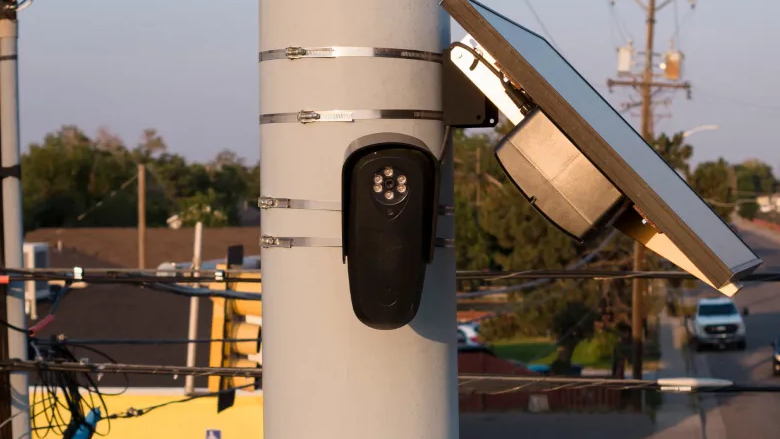
STATEWIDE - An Oklahoma federal court ruling striking down the warrantless use of automated license plate readers has established a critical legal hurdle for police departments across Ohio that rely on interconnected vehicle surveillance networks to do their job.
The decision, handed down Oct. 1, 2026, by U.S. District Judge Sara E. Hill in the Northern District of Oklahoma, marks a major judicial rejection of the operational framework used by systems like Flock Safety and VehicleManager. The court ruled that using these systems to access an individual's historical location information over an extended period violates the Fourth Amendment when conducted without a warrant.
While the ruling is not binding precedent in Ohio, which sits within the Sixth Circuit jurisdiction, the decision provides a detailed constitutional roadmap for defense attorneys seeking to suppress evidence derived from passive license plate reader databases.
In the 38-page opinion for United States v. Melisa Susan Kyle, Judge Hill explicitly characterized the automated networks as a type of "indiscriminate mass surveillance". The court noted that instead of targeting a single individual, the technology passively catalogs the movements of all vehicles that pass by any network-connected camera at all times, serving the information up to law enforcement across the country on demand.
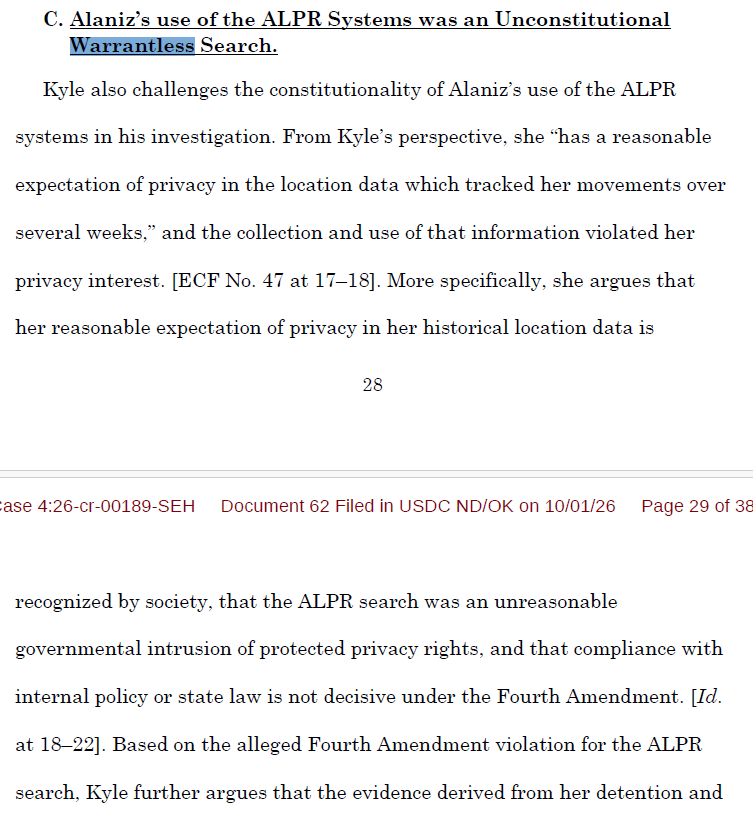
The court rejected the government's primary argument that drivers have no reasonable expectation of privacy because license plates are in plain view on public roadways. Grounding the decision in recent Supreme Court precedents, including Carpenter and the 2026 Chatrie decision regarding geofence location data, Judge Hill held that citizens retain a reasonable expectation of privacy in "the whole of their physical movements".
The ruling directly impacts how law enforcement utilizes historical lookbacks. In the Kyle case, a Tulsa County deputy used a vehicle-mounted camera to log a California plate and subsequently queried the Flock database. The search revealed a detailed, multi-state log of more than 50 individual location records tracking the car over the preceding month.
Because the deputy conducted this historical search without probable cause or a warrant, Judge Hill ruled that the tracking unconstitutionally intruded upon the driver's privacy. Furthermore, because the unconstitutional search led the officer to follow, stop, and ultimately detain the driver, the court suppressed all subsequently uncovered evidence—including physical contraband and voluntary admissions—as fruit of the poisonous tree.
The legal logic poses an immediate challenge to police practices in Ohio, where local municipalities have extensively deployed automated license plate readers that share data across regional jurisdictions. Ohio law enforcement routinely uses these 30-day databases to retrospectively track vehicles and establish reasonable suspicion for investigative stops.
Under Judge Hill's framework, any investigative lead or traffic stop in Ohio generated by a warrantless historical database query could be deemed an unconstitutional extension of police power, rendering any resulting evidence inadmissible in court.
The court acknowledged the Fourth Amendment requires a clear line against indiscriminate government data collection. The opinion concludes that without an adequate legal basis, the government cannot passively catalog public commutes or compile sensitive location history regarding visits to medical clinics, lawyer offices, or businesses.