One State, Under Wexner
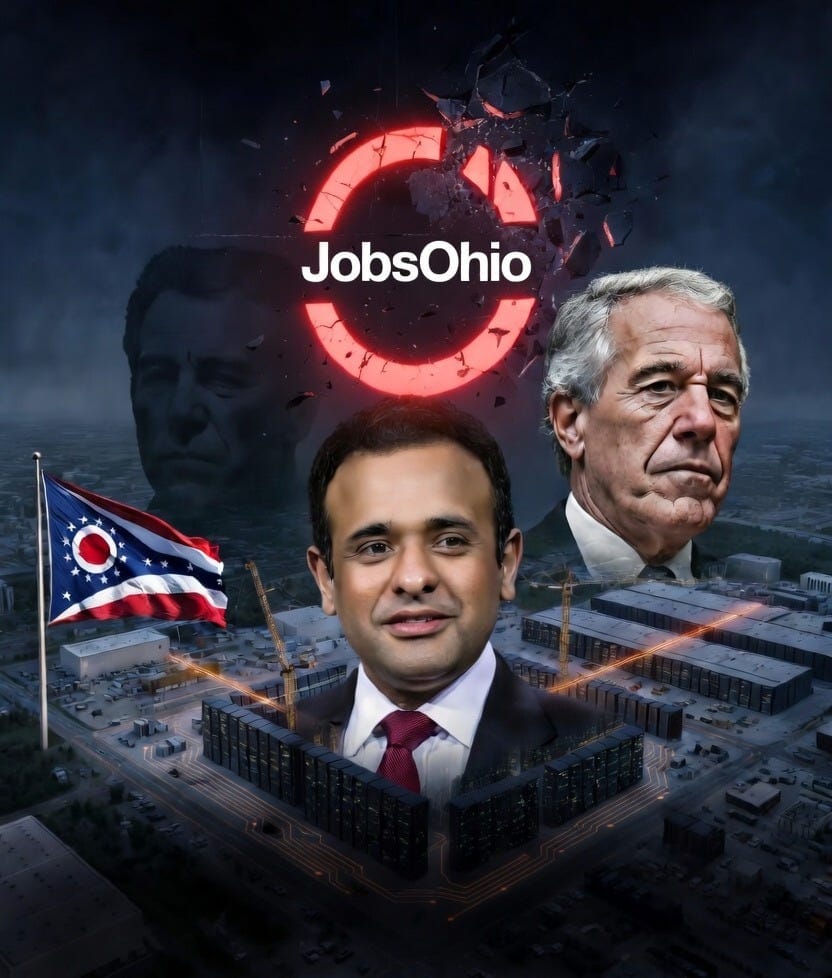
How Leslie Wexner, Jeffrey Epstein, and Vivek Ramaswamy Are Privatizing Ohio’s Government, and Violating the Social Contract
This Article Originally posted on The Heartland Beat:
The social contract is supposed to be ironclad: we the people hand over our taxes, our votes, and a slice of our freedoms so that government — protects the public interest, builds infrastructure, and stops elites from treating the state like their personal ATM. Information in a recent investigative report from Unlimited Hangout show that in Ohio, that contract hasn’t just been bent. It’s been ripped up, shredded, and fed through the woodchipper of public-private “partnerships.”
We have previously covered Leslie Wexner and his ties to human trafficking. However, that is only the tip of the iceberg with the actual government takeover come from the center of the heartland. Leslie Wexner — founder of L Brands and longtime bankroller of the late Jeffrey Epstein — didn’t just build a suburb. He engineered an entire privatized governance machine that has now metastasized across the state through the JobsOhio program and its web of corporate front groups. What began as empty farmland in the late 1980s is today the epicenter of Amazon, Meta, Google, Microsoft, and Intel server farms — all sucking billions in taxpayer subsidies while Ohio families pay the price in skyrocketing electric bills, drained aquifers, polluted air, and gutted public services.
What has transpired in the Wexner controlled and governed New Albany isn’t “economic development.” The newly minted feudal system is elite capture dressed up as innovation. potentially most horrifying, the state is now faced with the prospect of electing a politician campaigning to supercharge this philosophy statewide;
Vivek Ramaswamy — the Ohio “native”, Strive Asset Management founder, and 2026 gubernatorial candidate whose entire philosophy of privatization, federalism, and “techno-efficiency” is a student of the game hoping to take the New Albany model to its logical conclusion.
The Background:
In 1986, Wexner and his longtime fixer Jack Kessler were cruising around central Ohio in Wexner’s Land Rover when they spotted vast stretches of empty farmland near New Albany. Wexner reportedly declared it his ‘future kingdom.’ They immediately formed the New Albany Company, a private entity that would function as de facto government. According to the Cleveland Plain Dealer, the group formed paper corporations that were spun off to obscure ownership. Landowners received “offers you couldn’t refuse” in order to sell to the pair under NDA’s and a strict master plan was imposed that still dictates every zoning decision, every development and every tax break today. The Public-private partnerships model Wexner pioneered in New Albany showed clearly that the ‘Private’ always dictates to the public.
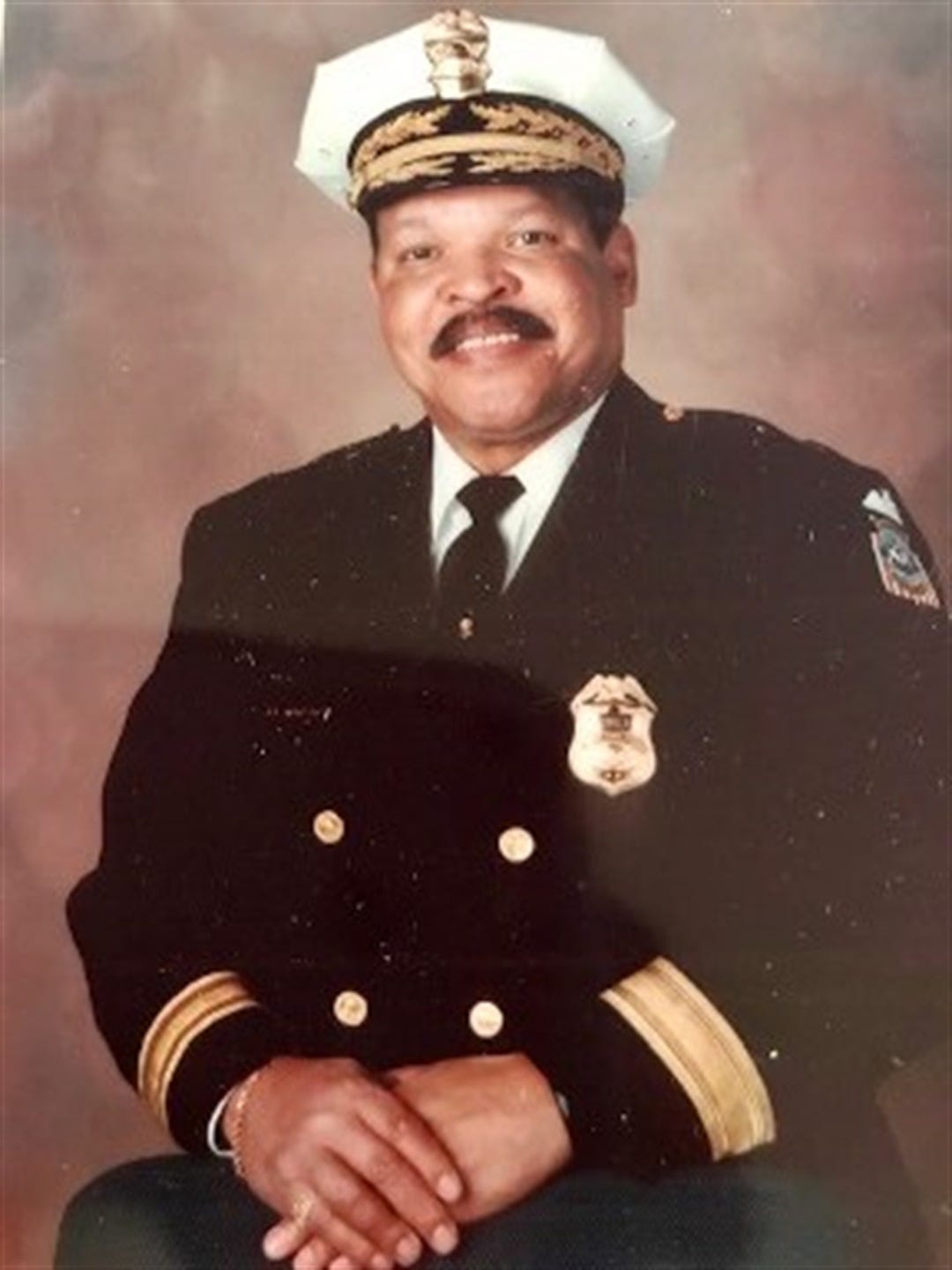
It was around this time that the groups financial lawyer, Arthur Shapiro, who was going to turn states witness in an IRS case involving the group, was assassinated in a mod style hit. The New Albany pair was initially fingered as suspects involved in the killing but thanks to the Columbus Police Chief James Jackson, the investigation was squashed.
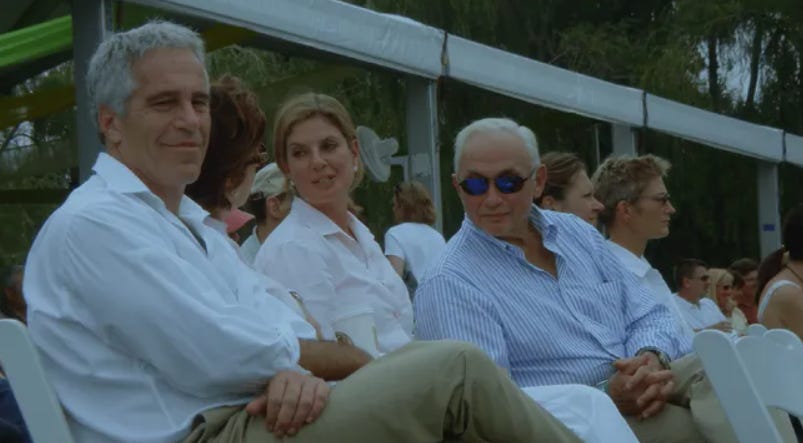
Jeffrey Epstein was brought in as Shapiro’s ‘replacement’ and wasn’t just a peripheral figure here either. He became a general partner in New Albany Property almost immediately. By 1988 he was co-president of the New Albany Company alongside Wexner himself. Court records and local reporting cited in the piece confirm Epstein funneled property acquisitions through Wexner-controlled trusts. He acquired homes in the suburb in 1990 and 1992. One was even described as a “gift” from Wexner before being sold back for $0 in 2007. Epstein maintained a branch of his financial advisory firm right there in New Albany into the 2000s, with staff rotating between Manhattan, New Albany, and his private islands. Ghislaine Maxwell later admitted Epstein “ran” New Albany for much of their relationship. Former New Albany CEO Gary Kerney even went on to manage Epstein’s infamous Little St. James island.
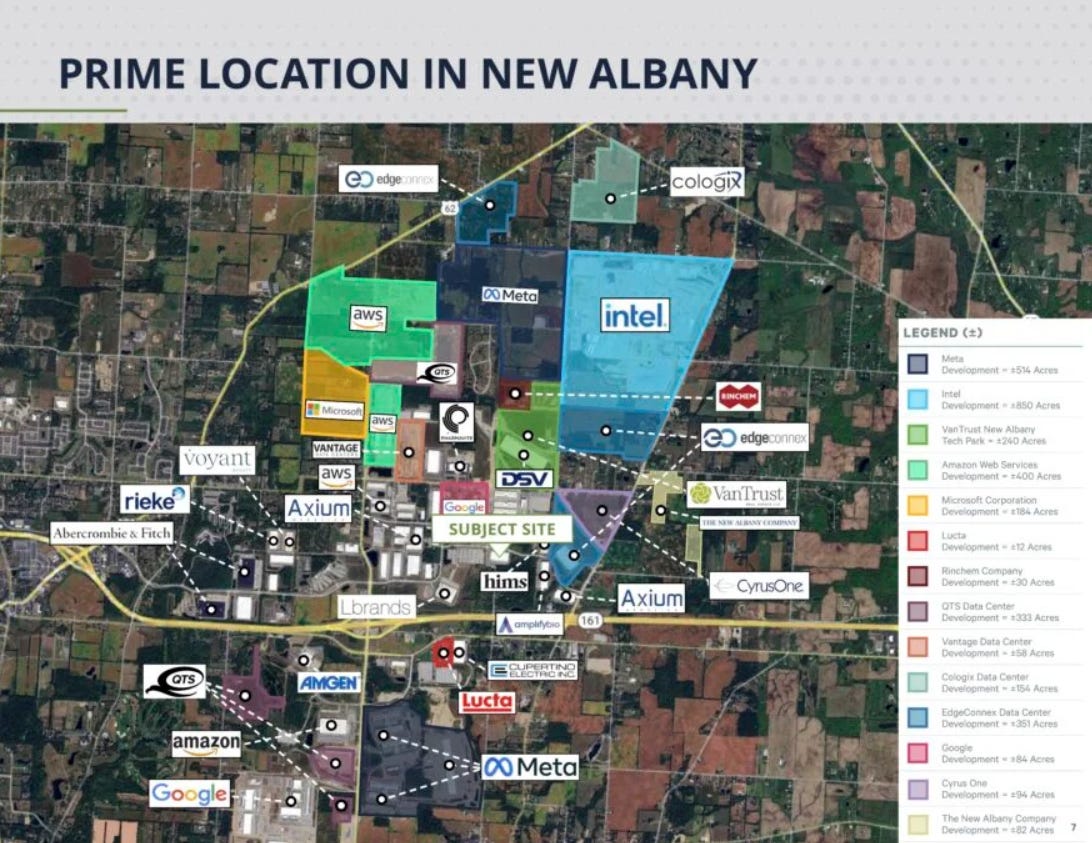
The business model was crystal clear from day one: privatize everything. The New Albany Company dictated land use. It strong-armed homeowners. It lobbied Columbus for zoning changes that funneled farmland straight into corporate development. Public government became a rubber stamp. Taxation, economic planning, and basic services were effectively handed over to private “techno-kings.” Population ballooned from about 1,500 in 1990 to around 11,000 today. The first data center arrived in 2014. Now New Albany hosts the world’s highest-capacity Meta facility and anchors the so-called Silicon Heartland — a sprawling complex of hyperscale server farms for every major tech giant. Ohio is home to nearly 200 data centers, with almost half in New Albany.
This local experiment didn’t stay local. Wexner and Kessler built the Columbus Partnership in 2002 — a private group that functions as the real economic development authority for 11 counties. It spawned One Columbus (formerly Columbus 2020), funded by corporations including Wexner’s L Brands, to court businesses with taxpayer money. The philosophy? Efficiency through privatization. Replace elected accountability with CEO control and remove public oversight completely. Divert public funds to corporate welfare and call it “public-private partnership” while the public gets the bill and the private gets the profits.
Enter JobsOhio — the crown jewel of this scam and the mechanism that scaled the New Albany model statewide. Created in 2011 by legislation signed by then-Gov. John Kasich, JobsOhio was sold to the public as a leaner, more efficient replacement for the old Ohio Department of Development. In reality, it was a privatization heist. The state leased its liquor tax rights for $1.4 billion — money that now flows straight into JobsOhio’s coffers with virtually zero public oversight. That lease was quietly extended to 2053 at no additional cost. The entity is chaired by lobbyists tied directly to Gov. Mike DeWine. It partners hand-in-glove with the Wexner-dominated Columbus Partnership and One Columbus. Not only has the program been a boon for siphoning government tax dollars, but it has been instrumental in bringing data centers to the state.
The numbers are staggering, or rather the ones we know about. JobsOhio has funneled more than $1.4 billion in taxpayer-backed incentives to corporations. Intel alone got a $2 billion package, including a 30-year tax break worth $650 million — even though the plant’s opening has been delayed until at least 2030. Data centers have received sales-tax exemptions and property-tax abatements that have already cost Ohio an estimated $1.6 billion in lost revenue. Anduril got $452 million. Independent research shows that in 75% of cases, these incentives don’t even influence companies’ location decisions — they’re pure corporate welfare, all going to technocratic businesses with strong ties to Epstein and Wexner.
Taxpayers foot the bill through higher utility rates, strained infrastructure, and diverted funds that could have gone to schools, libraries, and hospitals.
Critics — including dissenting Ohio Supreme Court justices in a related lawsuit — called JobsOhio an outright “abdication” of the state’s duty. Public money is spent with no transparency on job-creation metrics. There are ties to broader scandals, like the HB6 bribery mess that delivered $1.3 billion in bailouts to FirstEnergy while ordinary ratepayers got hammered, but without sweeping subpoenas, the extent of the grifting is unlikely to be fully realized. Yet the machine keeps humming: Wexner donated heavily to Kasich’s campaigns and the Republican Party to create the program and DeWine and Lt. Gov. Jon Husted have received Wexner-linked funding and The Columbus Partnership remains the connective tissue for all of it.
The human cost is what crosses into a strict violation of the social contract. Data centers are energy hogs. Residential power bills in central Ohio have jumped dramatically. Aquifers are being drained to cool the servers. Air and noise pollution have residents reporting health issues — lung problems, disrupted sleep, declining quality of life. Jobs? Mostly temporary construction gigs that vanish once the concrete sets. Permanent employment is minimal compared to the subsidies. Schools and libraries are starved while billions flow to tech giants who pay little in return.
In 2025 Wexner boasted that “probably the largest AI investment in the world will happen in Columbus.” your tax dollars are building the future — just not for you.
A Wexner Puppet for the Future:
This is where Vivek Ramaswamy enters the picture — not as some outsider reformer, but as the logical heir to the Technocracy. In 2019, under the Kasich-to-DeWine transition, InnovateOhio was launched — a state initiative to “modernize” government services digitally and market Ohio to outside businesses. Ramaswamy joined its board.
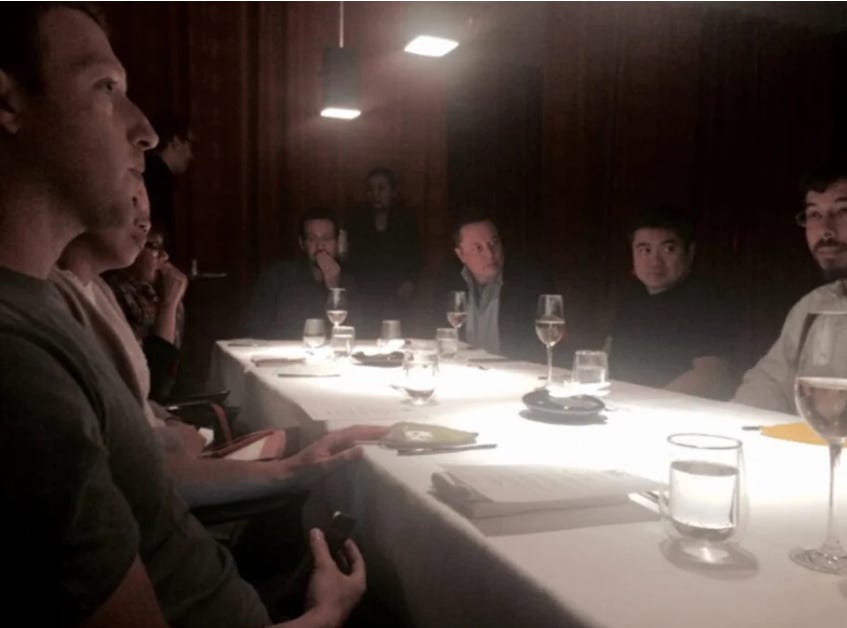
The board was stacked with Wexner-connected players: Mark Kvamme (a major Kasich donor who helped launch JobsOhio), Bernie Moreno (Wexner-funded), J.D. Vance, and others tied to Peter Thiel’s network. The advisory board was chaired by Falon Donohue of Narya Capital — co-founded by Vance and directly linked to Peter Thiel’s Mithril Capital. Ramaswamy’s own Strive Asset Management received funding from Narya, Thiel’s Founders Fund, Howard Lutnick’s Cantor Fitzgerald, and Joe Lonsdale.
Ramaswamy has leaned into this model hard. He launched his 2026 gubernatorial bid with events in New Albany — ground zero of the privatization experiment. He talks endlessly about turning the Ohio River Valley into the “Platinum Belt,” the next Silicon Valley for AI, data centers, manufacturing, and energy. His running mate, state Senate President Rob McColley, accepted $5,000 from Wexner-linked entities in 2024 and has pushed legislation that entrenches data-center subsidies.
During Ramaswamy’s 2024 presidential run, a super PAC supporting him took $100,000 from hedge-fund manager Glenn Dubin — a longtime Epstein associate whose wife appears in the flight logs. The PAC promised to return the money after the Epstein documents surfaced, then dissolved without doing so. Ramaswamy himself demanded full Epstein file transparency as a presidential candidate. He’s been noticeably quieter now that he’s running for governor — even as Congress deposed Wexner this year and unredacted records named him more than 1,000 times.

None of this is accidental. Ramaswamy’s core pitch — “constitutional revival through federalism,” shrink bureaucracy via DOGE-style efficiency, let states become laboratories for privatization — is the New Albany/JobsOhio philosophy scaled up. He wants to replace public accountability with private techno-kings. He wants taxpayer money funneled to AI and data-center barons. He wants Ohio to lead the next technological era the same way New Albany led the last one: by handing the keys to the same elite networks that built the Technocracy in the first place. They are literally all over his rise to prominence and funding.
The broader philosophy is straight out of Iain Davis’s The Technocratic Dark State: ultra-wealthy CEOs and investors privatize the public sector under the banner of “efficiency.” Government becomes a subsidiary. Citizens become customers — or collateral damage. This isn’t limited to one party. Kasich, DeWine, and the Republican establishment just built and expanded it here in Ohio. Ramaswamy now promises to accelerate it. The Columbus Partnership and One Columbus have operated with bipartisan corporate buy-in. The social contract doesn’t care about party labels when the result is the same: elites win, Ohioans lose.
Ohio families see it every month on their utility bills. They see farmland paved over for server farms. They see politicians who once railed against the swamp now swimming in the same corporate cash that has flowed through Wexner’s New Albany Company for four decades. Resident opposition to new data centers is growing, yet state legislation creates “commissions” to “dispel myths” and ram through more subsidies. Even some judges have called this setup unconstitutional, yet the machine rolls on because the incentives are aligned for everyone except the people paying the taxes.
Ramaswamy’s spokeswoman continues to insist the candidate runs on small-dollar grassroots money — conveniently sidestepping the documented ties to Wexner donors, Epstein-adjacent PAC cash, InnovateOhio board seats, and the very public-private machine that has already turned central Ohio into a subsidized playground for global tech giants.
The 2026 gubernatorial race is no longer about left versus right or Trump versus DeWine. It is about whether Ohio will keep surrendering its government to the technocracy — or finally demand that the social contract be honored again. Will we let JobsOhio keep writing blank checks to data-center billionaires while our power bills climb and our services crumble? Will we allow the Wexner-Epstein legacy to dictate the next decade of “innovation” through the same privatized model that has already cost us billions and seen our children sacrificed to trafficking?

The social contract has been shredded in plain sight for Ohioans. We do not currently have a government, but a feudal state of internationalist traitors, loyal to foreign nations and grifting. The question now is whether Ohio voters — the real stakeholders in this state — will let Ramaswamy and the privatized elite finish the job, or whether they will finally take their government back.