Putsch: The Anti-Property Tax Candidate and The Policy That Could Actually Make It Work
BY JEFF SKINNER
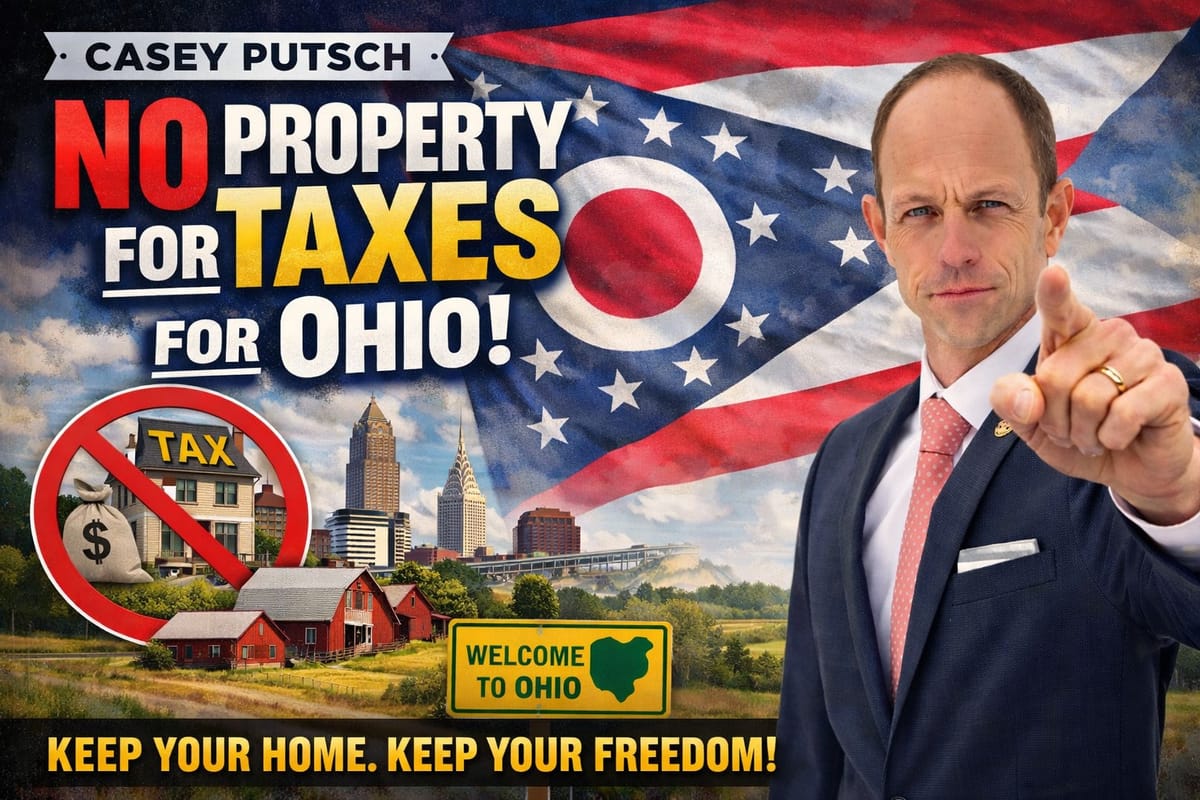
STATEWIDE - Despite many Ohioans either being unaware that there is a contested Republican Primary or have consigned to a fatalistic view of the cooptation of the electoral process by billionaires, The Republican Primary is indeed moving forward. At least three candidates are currently vying for the sought after Republican ticket spot for Ohio governor yet only one has come forward both in support of abolishing property taxes for Ohioans and bringing a solid plan to transform a dream where Ohioans own their own homes permanently into a reality where the state could very well become a shining beacon on a hill.
Casey Putsch, as inverse to Vivek Ramaswamy, has come out in open support to abolishing property taxes and has vowed to work with the Ax Ohio Tax team to develop a real, comprehensive strategy for how the state could not only function without property taxes, but also stave off some of the largest pitfalls of the initiative that no other candidate is currently considering or likely to care about.
As another direct inverse to major party candidates, whose policy team is built around donor demands, Putsch’s team consists of aerospace engineers, led by George Roush, that have taken the ideas presented by Ax Ohio Tax, and through meticulous research and development come up with a sound strategy they believe will not only make it a reality, but an imperative for Ohio’s future. In this first piece from the initial interview, TOR will be diving in-depth to the strategies and policy platform the Putsch team has developed to answer fundamental questions Ohioans have been asking, with a focus on property taxes and housing specifically.
“We are actively working to develop strategies to make Ohio perform better than it does, to fix a lot of the bureaucratic issues Ohio is facing," Roush said. “It all really depends on whether the tax initiative goes through. If it does, then we are in a much better position, because Ohio is going to be transforming from a taxes-paid-services model to a wealth-paid-services model, which is how some other countries and states actually operate. Alaska is an example of a state that operates on a wealth-paid-services model, where some of their oil investments actually help pay for the services that the state uses.”
What this means is that in lieu of Property Taxes, Ohio would need to create Sovereign Wealth Funds (SWFs) (or Social Wealth Funds) to invest state-owned assets, like natural resource revenues, and use the generated income to fund public services, stabilize budgets, or even pay direct dividends to citizens, creating a sustainable income stream beyond taxes or commodity sales, as seen with Alaska's Permanent Fund. This would not only mean having enough funds to pay for services, given plans which will be outlined below, but also potentially being able to rebate residents.
According to Roush, the current campaign of Vivek Ramaswamy and Amy Acton do not have policy experts or the knowledge to complete such an endeavor and would likely collapse back onto lazy strategies that would shift the burden back to residents, should the Ax Ohio Tax initiative move forward without Putsch in the driver seat.
“Ohio actually has kind of an asinine tax structure,” Roush said. “It's kind of ridiculous that tax rates change so much based on where you're located, and that we have such a large architecture to handle valuation of properties that it is an inherently inefficient system. So if the Ax OH Tax Initiative goes through, it does create a crisis for the state and bureaucrats have a handful of ways that they can respond. The most likely response is that the tax burden will, and this is if Vivek or Amy Acton gets in and they become governor. If it's Vivek or Acton, and they're in the hot seat, and the legislature is willing to work with them in any way, shape, or form, which I know has been an issue in Ohio, then what they will most likely do to backfill the missing funding for their various services is they are going to, 1: increase sales taxes, and 2: increase income tax, regional income tax through RITA.”
RITA is the Regional Income Tax Agency, an organization in Ohio that administers and collects municipal income taxes for nearly 400 cities and villages. Local municipalities such as Springfield Ohio, have used RITA to, in the short term, increase revenue streams through collecting what they believe to be ‘back taxes’ on residents that may still owe from previous filing periods. However, many have accused RITA of using unscrupulous means of collection and investigation, and in some instances, collecting taxes from those who should not be paying them, such as deployed military personnel. Because of their position, legal recourse is pragmatically nonexistent.
While many detractors who support the mainstream candidates may openly tell the public those candidates wouldn’t raise income or sales tax because ‘major party donors want to abolish income tax’ and in a state with high sales tax residents will just ‘shop in Pennsylvania’, this level of ignorance and misleading punditry shows a severe disconnect between what travel ability the average Ohioan has and hides the very obvious mutually exclusive goals of the major party donors and the movement itself. The likelihood of a Springfield Ohio resident that can readily travel four hours both ways to grocery shop in a neighboring state is on par with a mRNA vaccine that doesn’t have death as a potential side effect.
Similarly, the idea that billionaire donors will simply ‘roll over’ on their goals because of public outcry or have the wherewithal to manage such an ambitious statewide transition with major backings from groups like Somali Chamber of Commerce, is simply farcical.
Roush goes on to explain how, no matter who wins, if the amendment passes, any governor is going to have to deal with several key problems, including how do we fund services through the Wealth-paid services model and how do we ensure that the housing stock remains Ohio owned. Putsch’s team is the only one currently with strategies for both.
The first major problem is that property taxes currently act as a systemic limiter to major investment firms like Blackrock, Vanguard or Blackstone from simply buying up all housing stock in Ohio’s market. Abolishing it without any system guardrails would create a housing catastrophe for the average Ohioan no person has ever seen on two ends of the spectrum. One is buying houses out from under people, forcing out new families from ever owning and the other is offloading low yield housing stock which would implode the market and devalue equity property owners currently have.
“It does create a scenario where now there is nothing forcing large companies who buy residential properties such as Blackstone and a handful of other companies to actually put property on the market,” Roush said. “So if rental prices drop below a certain threshold, a company that owns a large share of single-family homes that they're renting out in, let's say, Toledo, because Toledo is 55% rentals now and it didn't used to be that way, they can make the decision, below this price, if we remove our houses from the market and sell them, housing prices will go up and rent will go up, which will generate more profit than the actual rent that we would bring in if we artificially constrict the housing supply and we don't want that to happen at all.”
The solution to this issue comes down to a fundamental question of whether or not the housing property you own generates a profit. Not if it increases value or equity, but if it exists solely to generate revenue such as a business or rental.
“Other countries have worked through these systems in the past,” Roush said. “So, the first thing is if we eliminate property tax, it doesn't mean that there can't be a service fee. In our model, we are going to define between what is a profit-generating property and what is not. So, if you're living in a house, let's say that you are growing old, you're retiring, you live in your home or you're raising a family and you own a home for your family to live in or for you to live in your primary residence, that's yours and you're not generating a profit. If you own a second home and you live in it and you don't rent it out, that's also yours. You are entitled to have as much property as you want provided that you own it. But if you're operating a business or a sole proprietorship out of, let's say, your house and it's not a dual-use purpose where you happen to be selling Etsy stuff out of the garage while you're living there, if it's a specific profit-generating property such as a storefront or a rental property or any other commercial-use property in the state, well, then you are making a profit off of the services that are provided by the state. So, we will institute a service fee that is not for residences. As long as it's a residence, it's free.”
While the service fee associated with solely business properties will be flat, i.e not tied to property valuation, it will be scaled based on number of properties owned by said entity and scale exponentially based on the number of individual domiciles owned. This will prevent large investment firms from buying up massive housing stock if property tax vanishes. According to Roush, rates would obviously scale and fluctuate between large investment firms and smaller mom and pop style rental companies.
The next stage of how those fees are processed and handled is what truly makes this endeavor the only true viable plan to make the Ax OH Tax initiative functional for Ohio residents and answers the most pressing question of how will services continue to be funded without property taxes.
“We're going to create state wealth funds, just flat-out sovereign wealth funds, that are going to do that,” Roush said. We are working on a policy that we've been scouring the legal books to make sure that we're okay with this. We've been looking at the Ohio Revised Code as well as federal regulation just to make absolutely certain that we can do this. We're going to allow companies to pay their service taxes and potentially other taxes, but right now definitely the service fee They'll be able to pay their service fees in company common stock. This has never been done before in a state. It's been done by countries, but it has not been done by states. And it turns out you legally can do it.”
This wealth fund would be managed by fiduciary wealth managers that will invest on the state’s behalf and on the people’s behalf and with much higher yields that the current pension fund investment strategies. In addition, it will create a direct correlation between the success of businesses in the state and the wealth and betterment of Ohioans on the street level. In addition, the fund will be used to create specific industry corridors in Ohio with proper zoning definitions to ensure industries like data centers will be placed in specific sectioned zones best suited for them rather than over historic landmarks and residential backyard where they are currently doing the most damage.
These corridors would include investments into new forms of energy from things like nuclear to ensure there would not be drains on public utilities that the public has to bear the cost of with excess revenue generates from energy generated and sold back into the grid. This system would also completely remove the need to tax abatements, which have been used historically to shift the financial burden of industry creation onto residents, while providing little to no yield, in short, socializing costs and privatizing gains. The new wealth-fund initiative fixes all of that. There are deeper strategies for how the Putsch team plans to handle data centers, which will be discussed in a future piece.
“The goal is that it should be a self-accelerating system,” Roush said. “First of all, because we are not going out and buying stock and we are instead building our state wealth fund off of the companies in Ohio, we are directly incentivized to improve the performance of these companies. so as the state wealth fund does better, we are going to have more money for infrastructure and as we build more infrastructure, because we are using infrastructure as the lever to bring companies into Ohio instead of tax abatements, we are going to be able to attract more business and scale out industry even more effectively than we already were. So it becomes self-accelerating.”
Roush prefaced these concepts and ideas as always still in development, so as new issues and ideas come up, the team incorporates these into their models and evaluates them. Part of the reason other campaigns have avoided discussing platforms during campaigning is because it can be ‘pigeon holing’, or in the case of a disastrous candidate, be revelatory as to their true motivations, if they are honest about what they want to do. The Putsch campaign is attempting to change that with transparency and open discussion reflecting their populist learnings. They want feedback from Ohioans who may find holes or issues with their strategies because the office of Governor should be a public servant position for all Ohioans, not just those with money.
It should go without saying that these ideas and strategies which could see Ohio develop as a truly unique shining state in the union only exist under a Putsch governorship. Not because any other candidate is incapable of enacting them, but because all others lack the desire or will to do it. Governing is hard, and governing specifically for the people and not for billionaire transnationalists is often a game of weighing mutual exclusives. What political pundits and party loyalists often do not reveal is that offered choices are not binaries or foregone conclusions simply because someone has more money than someone else.
This type of mindset is not only antithetical to nature of the state and country’s founding but has led to decades of broken political systems that incentives foreign influence and a current tax structure in Ohio that has become so burdensome by unqualified and uncreative bureaucratic zealots that people are losing the land their ancestors built. One shudders to think of how the American Revolution would have played out if directed by our current bevy of 'elected representatives'. Primaries exist for a reason, to give you the choice and power in who represents you.
With two opposing ideas at odds during this coming election, between the Ax Ohio Tax initiative and the billionaire donor class that wishes to remove income tax, one need only ask themselves a few questions. Do we believe politicians who believe they can, despite decades of contrary evidence, ‘sway’ billionaires and foreign interest groups to not increase sales and income tax if property tax is abolished because they think every Ohioan is capable of surviving by driving hours out of their way to buy essentials or work in other states and who also have no strategies for funding services or protecting Ohioans ability to own a home and start a family without raising one or the other?
Or do we acknowledge a third position? One bred from the best and brightest heritage minds Ohio has made after generations of creating a territory so prosperous that every foreign nation is currently chomping at the bit to pilfer. Is Ohio a marketplace for the highest bidder from all corners of the world or a nation within a nation as the constitution claimed, composed of a people and culture that demands elected officials work for their betterment. The choice will soon be up to you.