Springfield Still Split Under Myopic Misalignments
BY JEFF SKINNER
SPRINGFIELD - The Springfield city commissioners met on Tuesday, January 13, for a session that was nearly half-filled with public comments urging government officials to refrain from full cooperation with ICE, yet ironically punctuated by a closing statement on housing availability and the lack of affordable options the city residents now face, ironically missing the connection between the two.
As the February deadline begins to loom ever closer for the expiration of Haitian Temporary Protective Status, some members of the public crowded to the podium on Tuesday, with most in attendance issuing pleas for the city commission to reach out to county and state leadership in an attempt to stave off or diminish any mandatory cooperation with Immigration Enforcement that may see many Haitians deported. Most used arguments to emotion, arguing they wish for all people everywhere to live in peace and that many Haitians they know are good people who do not ‘deserve’ to be deported. Others stated their children play on soccer teams with Haitian children, which did not seem to connect to any larger legal argument, but was used as anecdotal justification as to why illegal immigrants should be allowed to stay.
Ironically, the meeting was punctuated with a closing statement from Commissioner Tracy Tackett, who made a brief statement on the rising outcry of heritage Springfield residents struggling to find an affordable place to live in a city that used to be filled with them.
“As we have heard in the commission in recent months, the residents are facing real challenges when it comes to finding affordable places to live, we know it’s a crucial topic for our community and I believe we can work together to address it,” Tackett said.
Tackett directed residents who are unable to find housing to go to Findhelp.org, a website she says is designed to connect people with assistance programs.
Ironically, despite some residents and members of the Commission who have, for the past several years, chosen to, for whatever reason, not acknowledge the connection between the two issues of immigration and housing availability, the latter strikes at the heart of why the former is supported by half the populace.
Many argue the crux of the ending of Temporary Protective Status ultimately comes down to the laws of supply and demand. There are simply not enough houses, jobs or tax subsidy programs to care for the entire world in Springfield Ohio and many of the residents feel they are beyond the breaking point of feeling the squeeze that attempting to make it work has incurred.
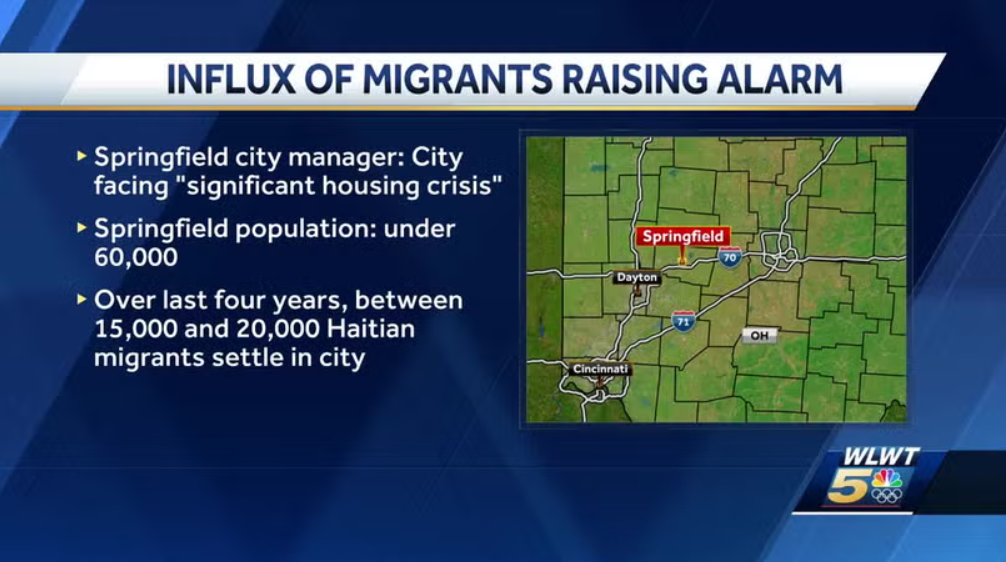
Over the last several years the city has endured a completely unknown number of mass influx from a foreign nation, with many being directly pipelined into the city through nefarious temporary employment agencies working hand-in-hand with Non-Governmental Organizations with a specific and stated goal of replacing heritage populations in the rustbelt. This influx has been estimated to be anywhere from 15-25,000, roughly half the previous population size of the former blue-collar, factory city.
The issues that accompanied that influx has escalated beyond simply ‘growing pains’ as described by city leadership, but a real crisis of affordability for a city whose residents relied on rental units totaling around $2-300 a month from jobs that paid at best $15 per hour. Even removing the issues of rising crime and safety concerns that accompanied the influx, residents who were already struggling found themselves squeezed harder from increased competition for jobs and housing from migrants with thousands of dollars in federal subsidies behind each individual.
Despite attempts by city leadership to paint the issue as a small minority of ‘racists’ mad about people with different skin color, the true root of frustrations comes from reports of warming centers seeing a large spike in homeless individuals who have been displaced from their rentals by landlords who prefer to rent to government vouchers worth far more and people living in their cars because they can no longer afford the spike in costs.
In Springfield, there is only so much space, so many houses and, as city leadership is aware, so many tax dollars to fund emergency management services that can be used in a given population set before systems start falling apart from strain.
Sadly, the story of Springfield has been told thousands of different ways, in multiple different cities across the country. It is the tired tale timelessly proven true that in order to ‘care’ for the world’s’ needy’, cities must sacrifice their own heritage residents to make room for them.