
Clark County Commissioner Race Comes To A Head

CLARK COUNTY - As Clark County voters prepare for the May 5 Republican primary for an unexpired seat on the Board of Commissioners, the four candidates — Daren Cotter, Greg Koffenbarger, Mark Sanders and Victoria Sorg — are outlining distinct platforms on economic development, public safety, infrastructure and long-term resource management.
Residents may recall the controversy surrounding the county Republican party appointment of a replacement to the seat vacated by Melanie Flax Wilt. Due to a schism, two different candidates were submitted to the Secretary of State for validation, however the battle led to a stalemate between two candidates currently running for the position.
The race centers on challenges including the county jail, workforce development, job growth, housing, transparency and debates over water use and large-scale projects such as data centers and solar farms which have incurred public ire. Below are spotlight profiles of each candidate, drawing from their forum statements and campaign positions.
Mark Sanders: Manufacturing experience and practical problem-solving;
Lifelong Clark County resident Mark Sanders of German Township brings 34 years of leadership experience at Honda, where he worked as a casting and tooling engineer before retiring and becoming a school bus driver. Sanders said his background in project management and crisis response equips him to address county needs with both proactive planning and reactive solutions.
On the county’s biggest challenges, Sanders identified the aging jail as a priority, noting that crime rates have not diminished despite new laws. He called for resolution on funding and location while emphasizing citizen safety and education. He expressed opposition to solar farms on prime farmland, citing the proposed Sloopy Solar project, and warned against treating the county’s position atop a major aquifer as “water for sale” for data centers that require extensive cooling and wastewater treatment.
Sanders advocated attracting well-paying jobs by planting seeds for skilled trades early in schools. He drew from Honda experience, where hands-on training with tools built pride and helped engineers transition to maintenance roles. He urged moving students beyond screens to learn trades such as welding, plumbing and electrical work.For spending priorities, Sanders placed public safety first but added support for the unhoused, referencing cases of exposure deaths and the need for seasonal warming centers. He called for capturing sales tax revenue currently spent in neighboring counties and ensuring courts address recidivism more effectively through fines while aiding those unable to help themselves.
On communication, Sanders praised recent evening meetings and work sessions and supported live-streaming to reach working and homebound residents. He said commissioners should treat taxpayers as employers.Sanders highlighted his proactive and reactive management skills, including overseeing large facility construction and rapid recovery after supplier disasters. Motivated by his 7-year-old son, he said he wants to leave Clark County better for future generations.
Greg Koffenbarger: Farming roots and community pride
Fifth-generation Clark County resident Greg Koffenbarger of Pike Township operates a family farm after earning a degree from The Ohio State University. He frames his self-employment experience as direct accountability: when the business succeeds or fails, his family feels it immediately, a perspective he said he would bring to county management.
Koffenbarger identified restoring pride in Clark County as a foundational step toward solving other issues. He argued that residents who feel proud of their community are more likely to support solutions for the jail, funding mechanisms and job growth. He agreed higher-paying jobs are essential and supported building a new jail despite challenges with location and funding, noting current overcrowding requires sending inmates to other counties.
For job attraction, Koffenbarger called for balanced attention across the county, including smaller communities facing food deserts. He highlighted innovation in agriculture, such as drone startups for crop analysis that can generate significant local income, and urged collaboration with the Chamber of Commerce and Greater Springfield Partnership while promoting both manufacturing and agricultural opportunities. On spending, Koffenbarger prioritized public safety and support for Sheriff Chris Clark while stressing careful management of employee health insurance costs and fair allocation across county services.
He advocated an open-door policy for communication, sharing that Pike Township residents visit his farm or shop directly. He listed his campaign phone number publicly and referenced a mentor’s accessible style in the Ohio Senate, saying he is willing to listen to all residents regardless of location. As a new grandfather, Koffenbarger said his perspective has shifted toward ensuring long-term opportunity so young people stay and thrive in Clark County, emphasizing protection of natural resources and restoration of community pride.
Victoria Sorg: Financial expertise and long-term vision
Victoria Sorg, a lifelong Clark County resident and Southeastern High School graduate, holds an undergraduate degree in financial economics from Wittenberg University and a master’s from the University of Northern Iowa. Her career spans financial advising at Lutheran Brotherhood and nonprofit leadership at the Springfield Foundation, Dayton Foundation and currently as director of revenue and external partnerships for a national political watchdog organization. She cited experience growing endowments from $60 million to $100 million and from $600 million to $1.1 billion.
Sorg views the lack of good-paying jobs as the county’s central challenge, arguing that many other issues stem from limited economic opportunity in residents’ pockets. She proposed stronger partnerships for job training, leveraging Clark State, attracting defense contractors due to proximity to Wright-Patterson Air Force Base and utilizing the county’s water for compatible manufacturing such as hydroponics. She explicitly opposes data centers.
For job strategies, Sorg emphasized career readiness pipelines and revitalizing brownfields with grants to create site-ready locations. She called for retaining young professionals to combat brain drain and building education-to-employment connections.
On spending priorities, Sorg ranked public safety first, citing high crime rates that deter new families and businesses. She advocated a thorough audit comparing Clark County to similar jurisdictions, contract reviews and efforts to boost sales tax revenue while respecting grant restrictions.Sorg proposed improving communication through civic education on tools like tax increment financing, live-streaming meetings, citizen committees for major issues such as the jail, continued evening meetings, dedicated commissioner office hours and public posting of bids and proposals.
She positioned her youth and 40-year personal stake — as a mother of three young daughters — as a unique strength, saying she has a direct interest in decisions that will affect the county for decades and wants her children to have opportunities to stay and thrive here.
Daren Cotter: Banking and economic development background
Daren Cotter, born and raised in Northridge, graduated from Kenton Ridge High School and Wittenberg University, where he played football. He spent 20 years at Fifth Third Bank, rising to vice president and Springfield city executive, and has served as CFO of the Turner Foundation for 15 years. He is in his 11th year as a Moorfield Township trustee.
Cotter identified jobs and quality housing as major challenges, noting thousands of residents leave the county daily for work. He highlighted the recent purchase and sale agreement for the former International Harvester/Navistar plant in Moorfield Township as significant for good-paying, potentially union jobs. He supported a better jail solution after voters rejected a prior proposal 80-20 and opposed solar farms on prime farmland, favoring alternatives such as nuclear power. He linked strong jobs, housing and schools to improved community morale.
For attracting businesses, Cotter pointed to the county’s Interstate 70 location between Dayton and Columbus and stressed workforce development. He cited aptitude testing and career fairs through the Community Improvement Corporation, which receives county financial support, to help students identify strengths in construction, agriculture and other fields.
On spending, Cotter described the county’s roughly $60 million general fund and $230 million overall budget covering courts, law enforcement and social services. He prioritized public safety and the jail while focusing on growing sales tax revenue through retail, housing and jobs that improve household income metrics.
Cotter advocated greater transparency through evening meetings, work sessions and televising sessions to combat misinformation, such as around tax increment financing projects. He drew from township experience where low attendance is common but emphasized informing residents about county decisions.
Controversies surrounding Daren Cotter’s economic development ties have brought some voters concerns. Cotter’s platform includes strong support for economic development, housing growth and addressing “50-year problems” such as the jail, solar projects and data center management. His leadership roles have sparked debate over potential conflicts of interest and influence on water-use and incentive decisions.
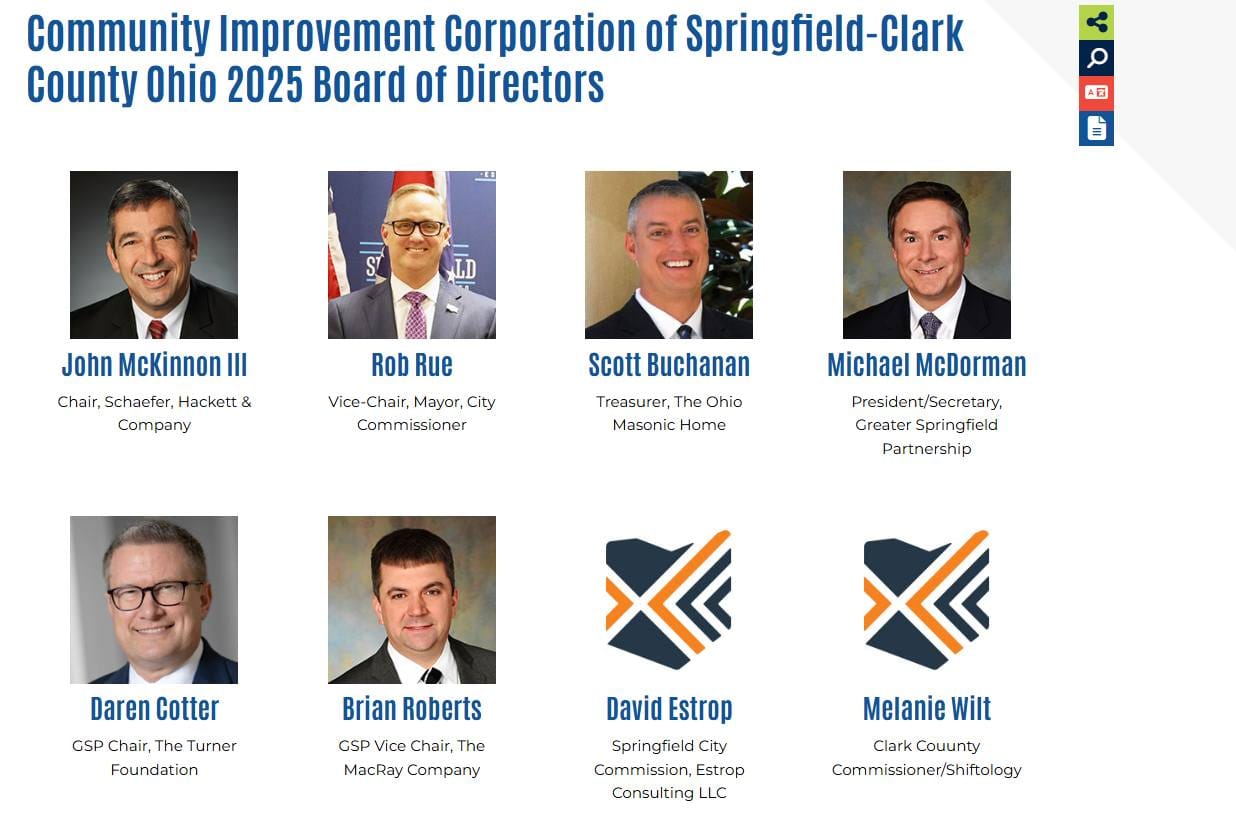
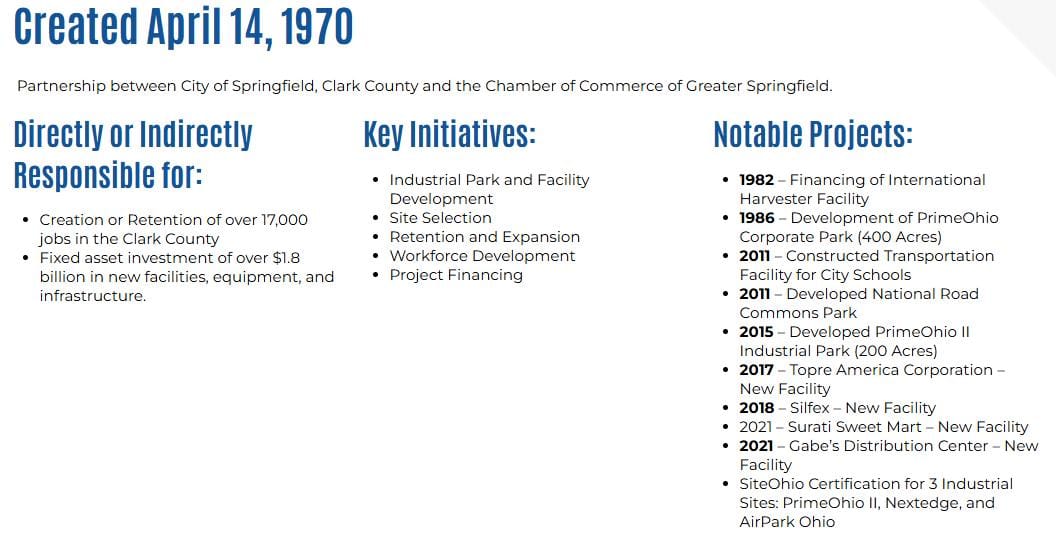
Cotter chairs the board of the Greater Springfield Partnership and serves on the board of the Community Improvement Corporation (CIC) of Springfield and Clark County, which the Partnership administers. The CIC, founded in 1970, has certified over $300 million in industrial development bonds, constructed speculative buildings and industrial parks, and facilitated land assembly, rezoning, infrastructure development and incentives for private projects, including the Melody Parks 1,200-unit housing development on approximately 400 acres.
Ohio law authorizes CICs under Chapter 1724 of the Revised Code to promote economic development, including issuing revenue (conduit) bonds for eligible industrial, commercial or research projects. These bonds are repaid solely from private company revenues or lease payments, not backed by city or county credit, with interest capped at 8%. The CIC board is appointed by the Springfield City Commission. City and county officials have served on the board, and the City of Springfield and Clark County have been listed among major contributors to related efforts. Cotter previously contributed as a Platinum Supporter ($10,000 or more) to the CIC.
Cotter has placed campaign signs at 20 S. Limestone St., the address associated with CIC offices. Questions have been raised about the appropriateness of this placement given his board service and potential votes on initiatives the CIC and Partnership advance.
His campaign has received contributions from numerous individuals and entities with ties to local business and government, including Rob Rue, Bernie Willis, John Federer, James McGregor, John Landess, Jay Flax, D.P. McGregor, James Kincaid, Richard Lohnes, Jeanette Chu, Mike McDorman, Bridget Houston, New Carlisle Federal Savings Bank, Tom Loftis, Sasha Rittenhouse, Pamela Littlejohn, Charles Patterson, Ross McGregor, Sunny Dhingra, Lamar Companies and Carmae Catering, among others. No compensation is publicly listed for his CIC board role.
Data centers have emerged as a flashpoint in Clark County due to their high water consumption for cooling, significant electricity demand and limited local job creation. One data center already operates in Springfield’s PrimeOhio Corporate Park within city limits, with reported expansion activity. Additional proposals, including projects associated with Constant Company LLC or 5C Data Centers, have involved discussions of tax abatements and Enterprise Zone incentives.
The CIC and Greater Springfield Partnership market industrial sites and support prospect responses, including in water-accessible industrial parks. While county commissioners do not approve projects inside city limits, they influence county-wide water policy, land use outside municipalities, infrastructure and long-term resource decisions.
The CIC and Greater Springfield Partnership market industrial sites and support prospect responses, including in water-accessible industrial parks. While county commissioners do not approve projects inside city limits, they influence county-wide water policy, land use outside municipalities, infrastructure and long-term resource decisions.
Critics argue the interconnected nature of city appointments, county contributions, CIC activities and Cotter’s donor base creates potential influence on how limited resources such as water are allocated. Supporters note that IDBs and incentives carry no direct taxpayer guarantee and are designed to stimulate private investment and job creation.
Cotter has stressed using his banking, nonprofit and township experience, along with established relationships, to work across lines on honest issues facing the county.
The primary on May 5 will determine the Republican nominee for the commissioner seat. Voters will weigh each candidate’s background, policy proposals and approaches to balancing growth, resource protection and transparent governance.