Clark County Residents Push Back on Selected Jail Location, Demand Greater Transparency
BY JEFF SKINNER
SPRINGFIELD - The Board of Clark County Commissioners faced a wave of public skepticism and direct pushback from area residents during a tense, heavily attended listening session held yesterday evening. The public forum, intended to detail the preliminary site plan for a new, $125.7 million county jail and public safety complex, instead exposed a deep rift regarding transparency and community safety.
While county officials and residents universally agreed that the current, overcrowded Fountain Avenue jail is structurally crumbling and well past its operational end-of-life, the choice of the proposed location has ignited a fierce local firestorm.
The flashpoint of the meeting centered on a site nestled just west of State Route 72 North, located precisely south of State Route 334. Local residents argue that the Board is actively choosing a site that compromises the safety of local neighborhoods and children simply to grant the Sheriff’s Office more convenient access to major thoroughfares.
The primary grievance voiced by multiple attendees was the proposed complex’s proximity to major family landmarks. The designated 50-plus acre plot sits immediately adjacent to the Springfield Youth Soccer Association complex and is down the street from Splash Zone, the city's only public water park.
"I am asking why this is the best place to put it," resident Tabitha Randall stated during the public comment portion, noting that she has already gathered 250 signatures on a petition opposing the choice. "We have the soccer complex where children play and families come to watch. We have the water park where families spend their summers... Protect the places where children play."
Former park district sergeant ranger Steve Southern also warned that the historic Simon Kenton bike path, which runs alongside the property and serves as a major recreational artery, faces significant disruption and would be forced into a reroute. Residents expressed fear that individuals released from custody, who often leave the facility on foot without pre-arranged transportation, would naturally migrate onto the bike trail or into nearby residential areas.
Clark County Sheriff Chris Clark defended the location by emphasizing its direct connectivity to State Route 72, Route 334, and Route 68, which he noted allows emergency vehicles to deploy across the entire county with optimal response times. Addressing concerns over foot traffic, Sheriff Clark stated that the facility's main entrance and exit would empty strictly onto the divided highway of Route 72, and that double-locking electronic doors, multi-layered surveillance, and frosted window glass would completely prevent inmates from maintaining a line of sight to the soccer fields or water park. He added that the county has a "handshake agreement" with a transportation vendor to give released individuals a ride, though he acknowledged that those no longer in custody legally possess the right to walk away on foot if they choose.
The tension in the room escalated when residents pressed the Board on how this specific plot of land was selected. During the formal presentation, officials revealed that after a previous proposal on Route 72 South failed a public sales tax ballot initiative in November 2025, the county conducted a massive property evaluation process.
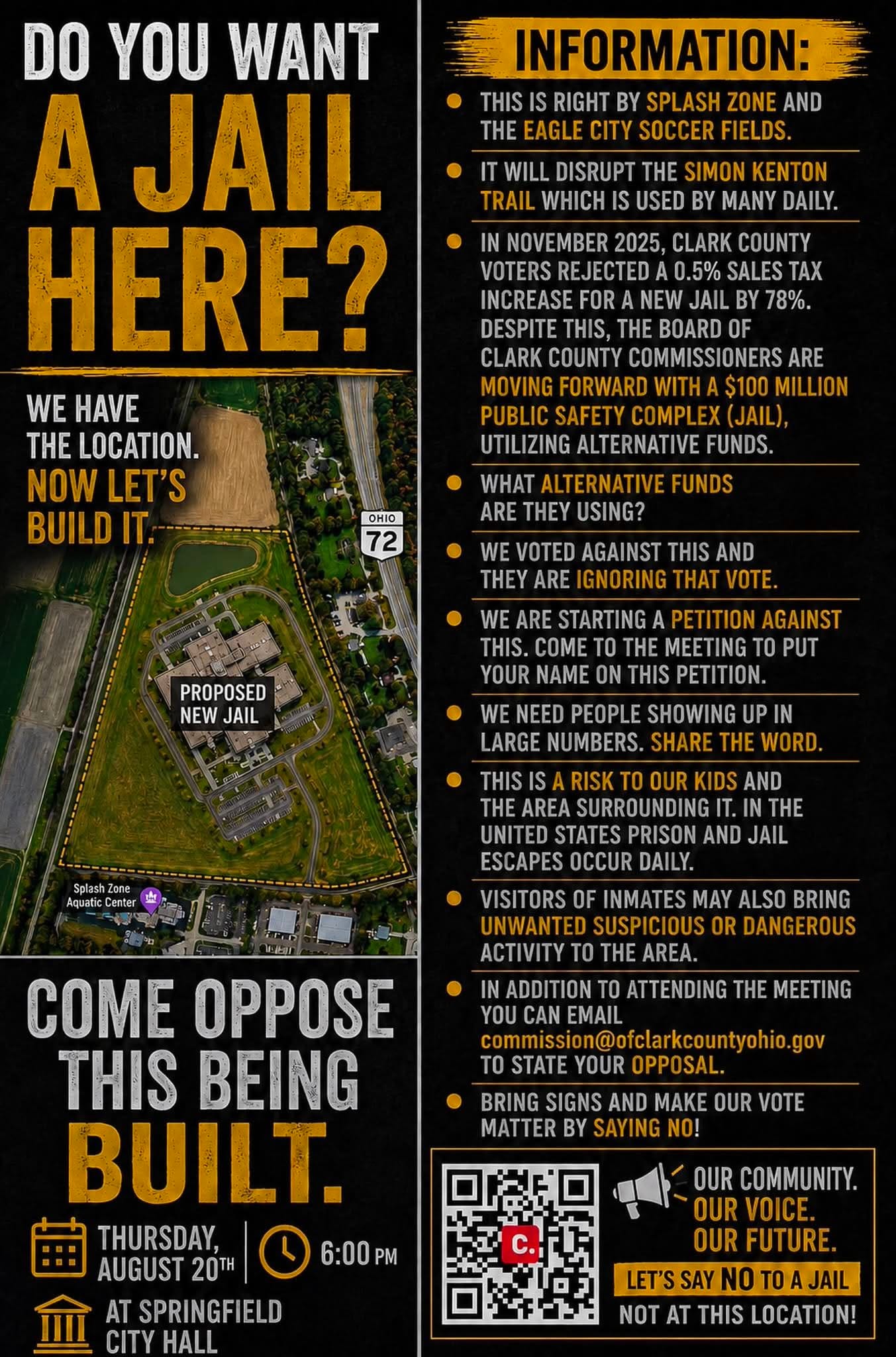
Between January 2026 and August 2026, county leaders evaluated more than 30 potential sites across the region. However, when residents demanded to see the full list of these alternative locations, the Board flatly refused to disclose them.
Officials stated that the details regarding the other 30 sites are strictly protected under Ohio law because the preliminary discussions took place behind closed doors during executive sessions. According to the commissioners, disclosing properties that the county does not own or have immediate legal control over could violate statutory guidelines governing land acquisition. This statutory wall left residents visibly frustrated, with several arguing that the public is being forced to accept a controversial site next to a children’s playground without any transparent proof that less sensitive alternatives were legitimately exhausted.
Adding to the community's frustration is the question of why the complex cannot be built on an industrial or commercial plot requiring environmental cleanup, utilizing state funds rather than pushing into a pristine recreational zone.
Exacerbating allegations of administrative myopia, community advocate Melissa Rexroth leveled a stinging critique against municipal leadership, arguing that the current crisis is the direct byproduct of years of short-sighted urban planning. Rexroth pointed out that the city repeatedly dropped the ball by failing to aggressively pursue state and federal brownfield remediation grants years ago—funding that could have successfully decontaminated blighted industrial sectors and readied them for this exact type of infrastructural layout. By neglecting those proactive preservation initiatives, Rexroth argued, the city let viable, non-residential alternatives rot, effectively forcing the county into its current position of having to rush and scramble for a quick fix. This historical lack of foresight, critics say, is what ultimately pressured officials to invade a thriving family recreational zone rather than utilizing a properly reclaimed, pre-existing municipal footprint.
While records show that the state of Ohio has aggressively distributed millions of dollars through the Ohio Brownfield Remediation Program to clean up hazardous, idled commercial sites, Springfield city and Clark County officials confirmed they did not pursue a contaminated or blighted "brownfield" property for the public safety facility. Instead, the county opted to enter a $500,000 land purchase agreement with the City of Springfield for the Route 72 North farmland.
County Administrator Jenny Hutchinson defended the decision, noting that building downtown or utilizing tightly confined urban/industrial plots would force a vertical construction model. Consulting firm DLZ reported that a vertical jail would trigger a 40% spike in initial construction costs—pushing the price tag to $175 million—and tack on an extra $3 million in annual operational overhead due to the increased staffing required to manage multi-level inmate housing.
Because voters overwhelmingly rejected the 0.5% sales tax levy last year, the county must finance the $125.7 million project entirely within its existing means. Taking on the resulting $6.6 million annual debt payment will force a brutal 10% slice out of the county's $50 million general fund expenditures, necessitating deep cuts to non-mandated local services. Officials noted that taking on an even larger financial burden for a brownfield or downtown site was simply impossible without a tax increase at this stage.