The True Scope of Findlay’s Canceled Data Center Briefing

BY CAREY MORGAN
FINDLAY - While the public is already aware that Mayor Christina Muryn abruptly called off an August 12 virtual briefing with New Albany tech officials, newly released public records reveal the gathering was far more expansive—and structurally coordinated—than the administration previously let on.
The documents obtained by The Ohio Register pull back the curtain on a quiet, multi-jurisdictional effort that directly involved local public school leadership. Furthermore, the intense internal pushback from key City Council members exposes deep fractures over transparency, leaving a glaring, unanswered question: Why is the Muryn administration pouring significant organizational effort into data center planning when the city officially maintains that no such development plans exist?
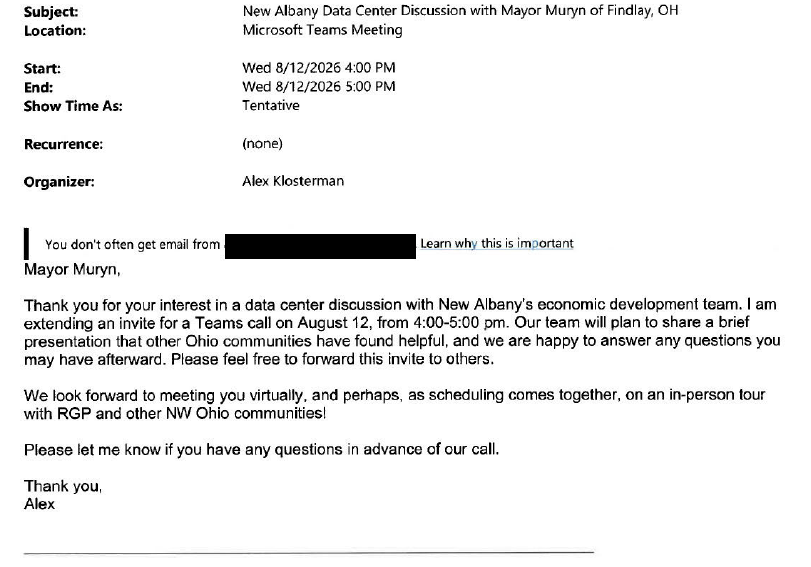
The city’s official stance remains that there are no active proposals or data center projects on the table for Findlay. Yet, the records seem to paint a picture of an administration operating with high-level urgency.
Behind the scenes, Mayor Muryn meticulously built strict legal bulwarks with Law Director Robert Feighner, consulted outside legal counsel briefings and studied how to set up a closed-door "educational seminar" that could technically be permitted under Ohio’s Open Meetings Act. The extraordinary level of forethought—combined with plans for future in-person regional tours with the Regional Growth Partnership (RGP)—strongly implies that data center infrastructure is being aggressively scouted, despite the lack of public transparency.
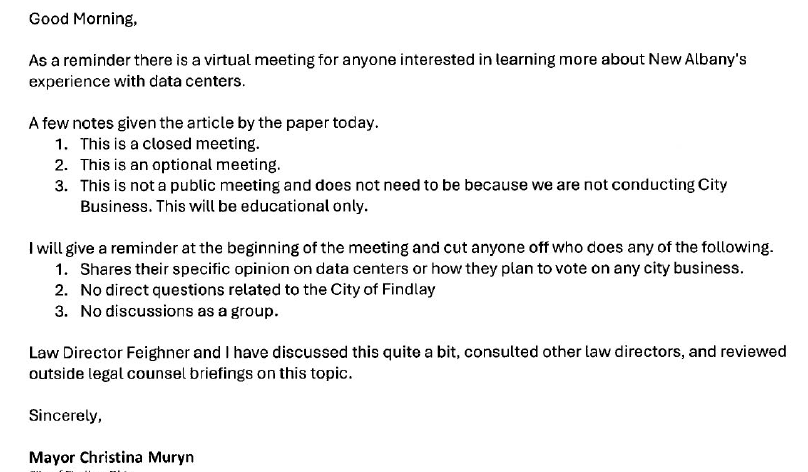
The most significant revelation in the newly released emails is that this was never meant to be a simple city briefing. It was designed as a joint coalition.
The meeting's mandatory reminder list explicitly loops in Andy Hatton, Superintendent of Findlay City Schools, and Dr. Jason Inkrott, Superintendent of Van Buren Local Schools. In Ohio, data centers heavily impact public education because their massive utility demands and multi-million dollar facilities reshape regional property tax assessments and trigger high-stakes corporate tax abatements.
By pulling regional education chiefs into a closed-door forum alongside city lawmakers, the records indicate the administration may have been attempting to build cross-district alignment on complex industrial tax frameworks well before the public or the media could ask questions.
The records show that council pushback extended well beyond generic complaints, revealing a deep discomfort with the engineered closed-door nature of the meeting.
While Councilman Rodney Phillips directly lambasted the private forum as a violation of the "spirit" of sunshine laws, other council members forcefully chipped away at the justification for the closed-door limits.
Ward 1 Councilwoman Nichole Coleman mounted a formal challenge to the legal structure, pressing the administration to stream the meeting directly to the City's YouTube channel.
"We have repeatedly told our residents that we are taking our time with data centers, gathering information, asking questions, listening, and educating ourselves before making decisions," Coleman said.
She pointed out that if council members were using a prearranged gathering to receive critical parameters on an issue of intense public interest, the public had a right to see it firsthand.
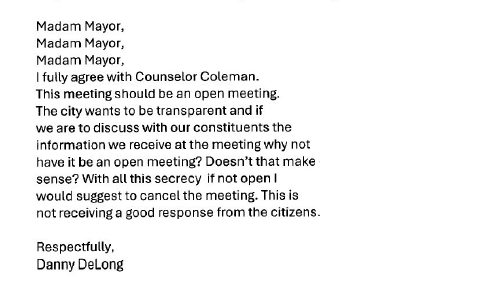
Councilman Danny DeLong fiercely aligned with Coleman, issuing a blunt warning to the Mayor that the "secrecy" was generating severe backlash among local constituents. DeLong flatly advised that if the city truly wanted to be transparent, it needed to open the link or kill the meeting entirely.
"The city wants to be transparent and if we are to discuss with our constituents the information we receive at the meeting why not have it be an open meeting? Doesn't that make sense? With all this secrecy if not open I would suggest to cancel the meeting."
Confronted with a cascading mutiny from council members who refused to participate in a highly managed, private information session, Muryn cancelled the Teams link under two hours before its scheduled start time.
The cancellation has successfully stalled the briefing, but it leaves an investigative vacuum. If Findlay has no active data center prospects, why were school superintendents mobilized and why a complex legal defense constructed to keep an educational meeting private?
Until the administration accounts for the discrepancy between its public denials and its private preparations, the mystery of what—or who—prompted the New Albany outreach remains wide open, for the moment.
Editor’s Note & Investigation Status
The Ohio Register has formally notified Findlay Law Director Robert Feighner that the city’s initial public records production is factually and legally incomplete under the Ohio Public Records Act, R.C. 149.43 based on the initial request made.
Internal documents produced by the city explicitly reference files that should have been included and were completely omitted from the initial release. The Ohio Register has demanded the immediate production of Mayor Muryn’s initial outbound correspondence to New Albany officials, internal text message logs, and the outside legal counsel briefings used to design the closed-door meeting framework. Updates will be provided immediately as this investigation unfolds.