FAA lifts rare nationwide ground stop after telecom crash sparks AI and diplomatic speculation
BY JEFF SKINNER
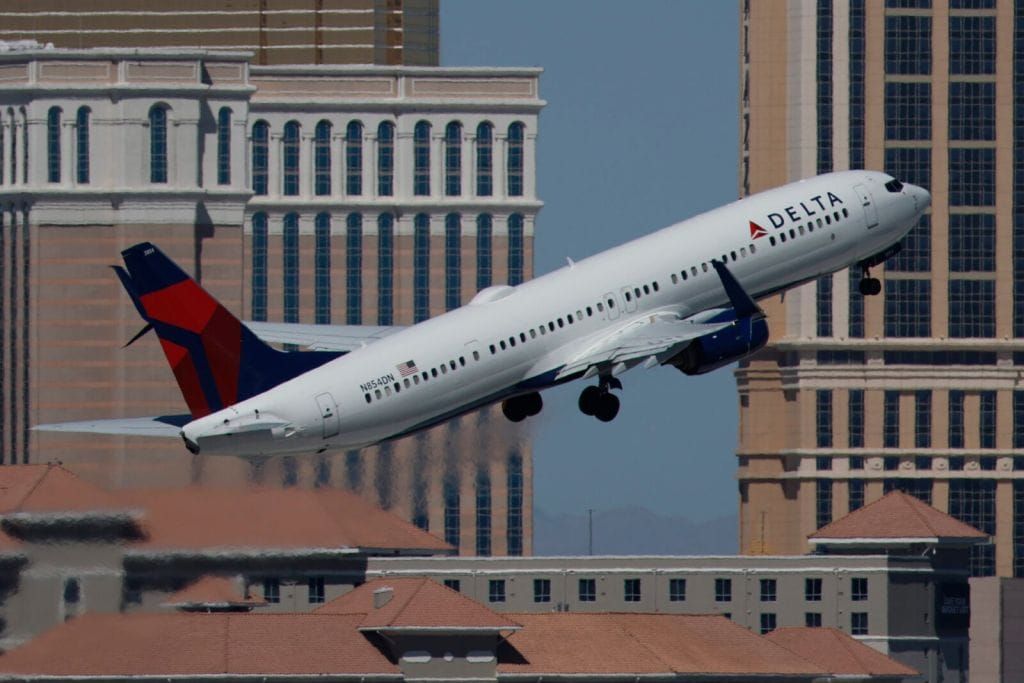
STATEWIDE - Federal aviation officials lifted a rare nationwide ground stop Friday evening after a sweeping telecommunications failure halted departing commercial flights across the United States for roughly four hours, stranding tens of thousands of passengers and triggering urgent questions over the fragility of the nation’s aging airspace infrastructure.
The shutdown, which took effect at 3:54 p.m. ET, marked only the third time in American history that the Federal Aviation Administration ordered a full nationwide halt to departing flights. The first occurred following the terrorist attacks of Sept. 11, 2001, when regulators closed U.S. airspace entirely for multiple days and ordered all airborne commercial aircraft to land immediately at the nearest available airport. The second took place in January 2023, when a corrupted database file crashed the Notice to Air Missions pilot alert system, grounding domestic departures for several hours. Unlike the sweeping security lockdown of 2001, Friday’s order allowed flights already in the sky to continue safely to their destinations while keeping outbound aircraft parked at airport gates across the country.
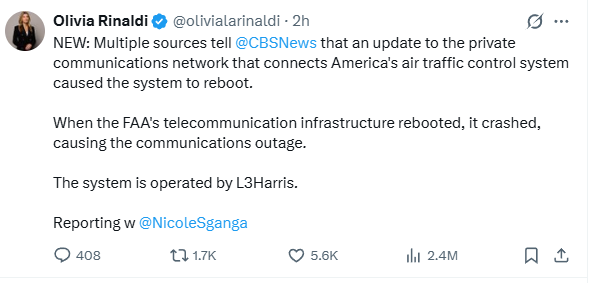
Transportation Secretary Sean Duffy and Homeland Security Secretary Markwayne Mullin attributed the stoppage to a severe communications outage affecting voice radio and radar data lines across nearly all 22 regional Air Route Traffic Control Centers. Early technical advisories sent to commercial airlines pointed to cascading network router failures near Chicago Midway International Airport on the private telecommunications backbone operated by Florida-based defense contractor L3Harris Technologies. Federal officials, alongside the Cybersecurity and Infrastructure Security Agency and the FBI, stated Friday evening that investigators had found no evidence of a cyberattack, foreign intrusion, or malicious tampering behind the crash.
Still, because the disruption occurred just three days after the FAA completed the nationwide rollout of its $875.9 million Strategic Management of Airspace, Routes and Trajectories system, known as SMART, aviation analysts are examining whether the massive software expansion played an indirect role. Developed by Boston-based Air Space Intelligence, SMART is a cloud-based planning platform hosted on U.S.-based Amazon Web Services servers. It ingests roughly 200 real-time data streams—including weather patterns, flight trajectories, airport runway capacities, and controller staffing metrics—to forecast airspace bottlenecks and recommend routing adjustments to human traffic managers in Washington and at the Air Traffic Control System Command Center in Warrenton, Virginia.
Air Space Intelligence issued a statement Friday afternoon explicitly rejecting claims that its technology caused the ground stop, noting that SMART operates on a one-way, read-only data model that does not interface with live aircraft radio frequencies or radar scopes. Even so, independent network engineers and aviation systems analysts point to three hypothetical technical pathways through which a large-scale cloud rollout could indirectly disrupt legacy telecommunications hardware sitting underneath it.
First, pulling hundreds of continuous real-time data streams across shared FAA Telecommunications Infrastructure circuits could theoretically flood older enterprise routers, exhausting their memory buffers and forcing sudden hardware reboots that drop critical voice and radar traffic. Second, middleware servers and security gateways used to package flight data from the FAA’s System Wide Information Management network for external cloud platforms could experience configuration bugs, memory leaks, or security certificate errors. If those overloaded gateways share physical racks, power supplies, or local switching gear with core telecommunications nodes, a rapid restart cycle in the data-export layer could disrupt neighboring communications equipment. Third, human engineers working to optimize data latency following Tuesday’s nationwide activation across all 22 regional centers may have pushed emergency routing table updates or firewall rule changes on Friday afternoon, inadvertently triggering a network loop across the private L3Harris backbone.
Still, others are not ruling out the issue stemming from the L3Harris communications infrastructure itself.
In the civil airspace sector, L3Harris performs two central functions for the FAA. Through the FTI program originally awarded to Harris Corporation in 2002, L3Harris owns the networking equipment and leases the circuits that transmit safety-of-life voice radio, radar feeds, and flight data across more than 4,400 FAA facilities. Separately, the company operates the nationwide terrestrial aircraft surveillance network, integrating data from over 700 ground stations to deliver real-time aircraft positioning to air traffic controllers. Online speculation immediately went to L3Harris given its recent connections to international military entities.
As domestic travelers remained stranded inside airport terminals Friday afternoon, the timing of the outage also fueled intense speculation across social media because it coincided with high-level diplomatic arrivals in Washington. According to federal officials and news reports, Mossad Director Roman Gofman traveled to the U.S. capital on Friday for scheduled meetings with CIA Director John Ratcliffe and White House envoy Steve Witkoff regarding regional security and potential military operations against Iran.
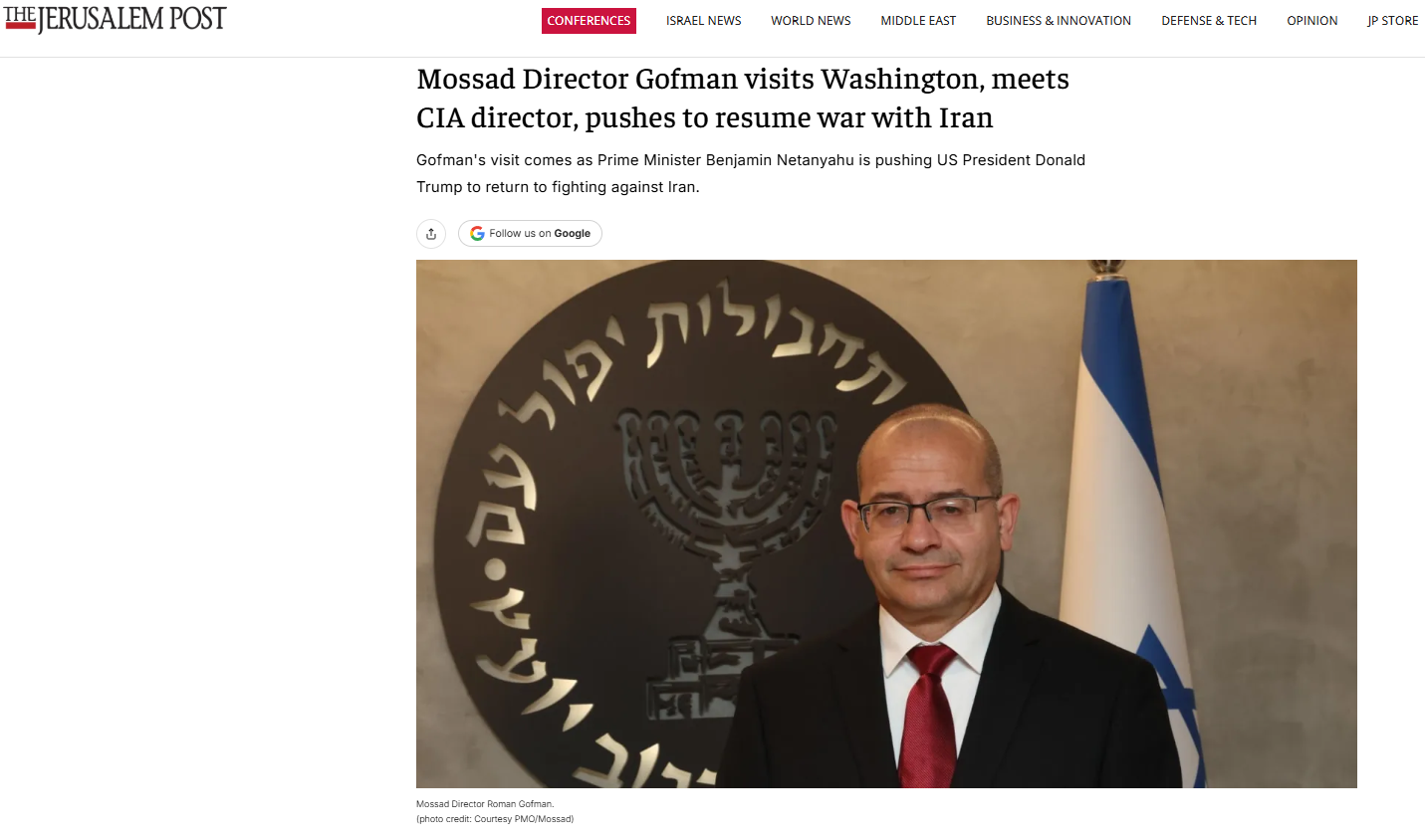
Online commentators quickly juxtaposed the grounding of commercial airline passengers across the United States with the arrival of the Israeli intelligence chief, pointing to L3Harris’s dual role as both the operator of more than 4,400 domestic FAA network sites and a defense partner to Israeli aerospace firms. In October 2025, L3Harris signed a Memorandum of Understanding with state-owned Israel Aerospace Industries to jointly develop a specialized light-attack and border surveillance aircraft, known as the Blue Sky Warden, for the Israeli Air Force. The company has also collaborated with Israel Aerospace Industries subsidiary ELTA on international defense bids, including a 2023 airborne early warning aircraft proposal for South Korea, and held preliminary talks in June 2022 to acquire Israeli surveillance software firm NSO Group—maker of the Pegasus spyware—before abandoning the deal following strong White House opposition. Prior to its 2019 corporate merger and subsequent divestitures in 2020 and 2021, legacy division L3 Communications also supplied diesel engines for Israeli military vehicles and body-scanning equipment used at Israeli checkpoints.
Nevertheless, the convergence of a newly deployed artificial intelligence platform, aging copper-and-fiber telecom circuits, and peak Friday afternoon travel volume has already drawn renewed scrutiny from lawmakers on Capitol Hill. Several members of Congress had previously called for a Government Accountability Office audit of the SMART contract and the FAA’s broader modernization timeline, warning that layering sophisticated cloud analytics onto decades-old ground infrastructure carries operational risks.
By Friday evening, technicians had restored primary telecommunications circuits across regional air traffic centers, allowing the FAA to lift the ground stop and clear departing flights for takeoff. Major U.S. airlines warned that residual delays, missed connections, and crew scheduling bottlenecks would likely persist well into the weekend as carriers work to reposition aircraft and federal regulators begin a formal technical review of what brought the nation’s aviation communications backbone to a standstill.