Geauga County Prosecutor Answers Questions on Office Remodel
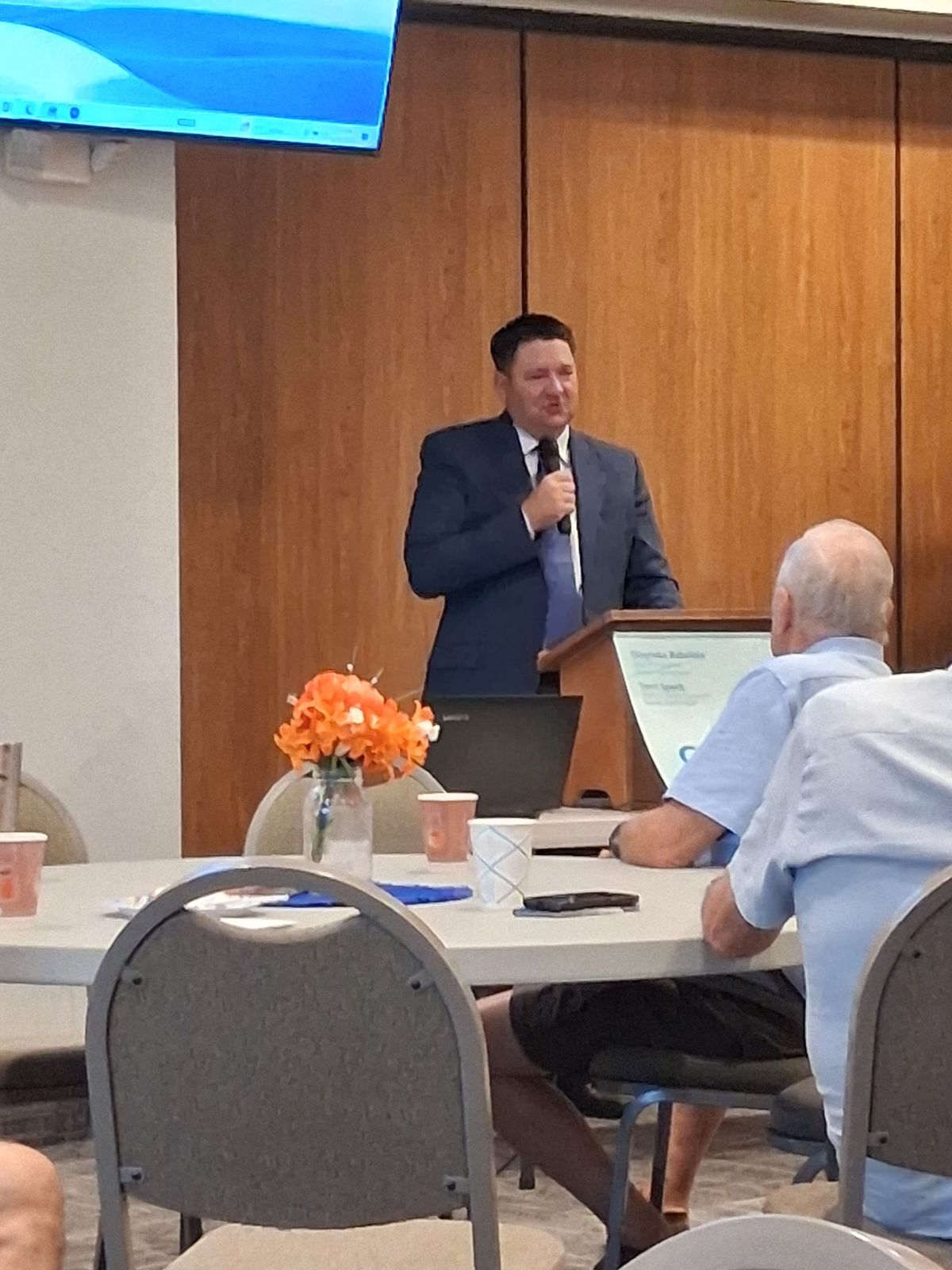
CHESTERLAND — Geauga County Prosecutor Jim Flaiz defended a controversial $380,000 renovation of his administrative offices during a local Rotary Club meeting this week, framing the high-grade ballistic upgrades as an absolute necessity to protect staff from potential targeted violence. However, Flaiz’s own presentation has drawn fresh scrutiny from critics, as he explicitly boasted on two separate occasions during the same meeting that the county is an exceptionally safe community with remarkably low rates of violent crime.
The discussion arose during a broader presentation where Flaiz provided local civic leaders with an overview of the county’s grand jury operations. The focus quickly shifted when pressed on why a costly lobby remodeling was necessary given the economic challenges currently squeezing taxpayers. Flaiz countered that public safety concerns made immediate structural upgrades imperative, detailing how the third-floor office previously lacked building-wide security and left administrative staff exposed to anyone walking off the street with a weapon.
To mitigate those fears, the county overhauled the lobby's structural footprint by stripping away standard tempered glass and replacing the entire front wall with level three ballistic glass, supplemented by reinforced ballistic paneling and a secure ballistic door. The project faced swift pushback from local fiscal watchdogs and former county officials, who lambasted the allocation as unnecessary "glamor spending," arguing that the public had not been presented with a sufficient case to justify the cost on the heels of a 33% property tax increase impacting area homeowners.
The central paradox of the defense, however, lies in how Flaiz described the actual threat level of the community he serves. While justifying the military-grade fortifications by evoking the threat of an intruder with an AR-15, Flaiz explicitly contradicted the notion of a dangerous local climate. "Fortunately, we're a safe community," Flaiz stated early in his remarks when explaining the office's routine schedule. He later doubled down on the assertion, telling the audience, "In our county, we're very fortunate in that we don't have a lot of violent crime."
According to Flaiz, Geauga County is so uniquely secure that his staff has the luxury to pursue lower-level property crimes that overwhelmed, high-crime neighboring jurisdictions are forced to ignore. Specifically, he noted that the lack of violent offenses allows his felony assistant prosecutors to aggressively pursue grand theft cases against professional shoplifters targeting major department stores and retail establishments. "Because we're a safe county... we can spend time on cases that the other counties don't spend time on," Flaiz explained, highlighting routine prosecutions of thefts exceeding $1,000 at local Walmart and Home Depot locations.
This explicit acknowledgement of a low-violence environment has provided fresh ammunition to critics who question the integrity of the safety narrative used to secure the $380,000. Skeptics point out the logical friction between describing a community safe enough to focus its felony resources on stolen Ninja mixers, while simultaneously claiming that office conditions are so perilous that workers require protection behind level-three bulletproof glass.
In response to the fiscal question raised at the Rotary meeting, Flaiz noted that the project ultimately concluded under budget. He also noted that a significant portion of the funding did not draw from the county's general fund. Instead, the money was pulled from the delinquent real estate tax fund, a specialized pool generated from administrative fees collected when delinquent commercial and residential properties are sold or settled following an owner's passing.
Beyond the physical safety arguments, Flaiz pointed out that structural renovations are a more cost-effective long-term strategy than hiring armed personnel. Stationing full-time law enforcement personnel at the annex entrance would require recurring operational funds, pointing out that a single fully loaded, full-time sheriff's deputy costs taxpayers roughly $120,000 annually in salary and benefits.
While the debate over county capital improvement spending persists, county officials have stood by the decision. During the initial authorization process, Geauga County Commissioner Carolyn Brakey defended the expenditure by emphasizing that the board had engaged in extensive evaluations of "wants versus needs," concluding that reinforcing the prosecutor's lobby directly resolved an unacceptable safety deficit for public servants.
The complete audio is available below