As Ohio Senate weighs international trade bill, critics question workforce impact of defense-tech boom

BY JEFF SKINNER
STATEWIDE — As the Ohio General Assembly enters the final weeks of its 2026 lame-duck session, lawmakers in the Senate Finance Committee are weighing whether to advance a proposal creating a state commission to foster bilateral trade and defense-technology investment with foreign nations which may have impacts on imported labor for the state, leading to a statewide 'Springfield' situation, and economically entwine the state's destiny to that of foreign nations.
While supporters promote House Bill 188 and similar international partnerships as vital economic engines for Ohio’s growing aerospace and technology sectors, populist critics and conservative activists contend that the push represents the culmination of a multi-year lobbying effort to build foreign tech pipelines into state institutions while bypassing native Ohio workers and local oversight.
Sponsored by state Reps. Thomas Hall, R-Madison Township, and Eric Synenberg, D-Beachwood, HB 188 passed the Ohio House 73-10 and would establish the 14-member Ohio Israel Trade and Innovation Partnership. A companion measure, House Bill 291, proposes a similar trade commission with Ireland.
Skeptics of the proposal have scrutinized that testimony alongside earlier legislative records. In June 2025, CEO Howie Beigelman, an international lobbyist pushing for the international integration of the state's technology sector, testified before a House committee in support of House Bill 283, a measure requiring local governments to adopt baseline cybersecurity standards.
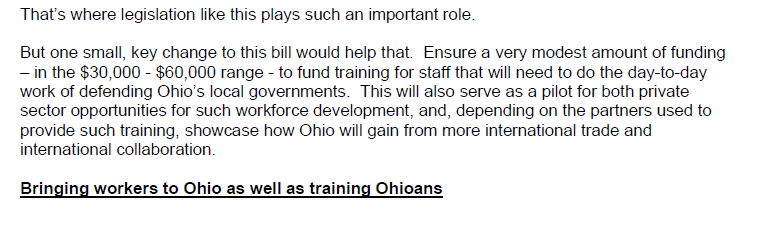
In his written testimony, Beigelman suggested amending the bill to include $30,000 to $60,000 in training funds for municipal cybersecurity staff, describing the proposal as a potential "beta test" for the international trade partnerships outlined in HB 188 and HB 291. Under a subheading titled "Bringing workers to Ohio as well as training Ohioans," Beigelman wrote that such programs could attract foreign direct investment while building a local cyber workforce.
State lawmakers ultimately enacted the local cybersecurity mandates into law as Ohio Revised Code Section 9.64 without Beigelman’s proposed funding amendment or any international partnership provisions, relying instead on domestic training through the state and the Ohio Cyber Range Institute. However, internal communications from Beigelman obtained via public records request from 2025 indicate the legislation from HB 188 and HB 291 are continuations of the effort for economic and cyber security integration of the state with foreign nations.
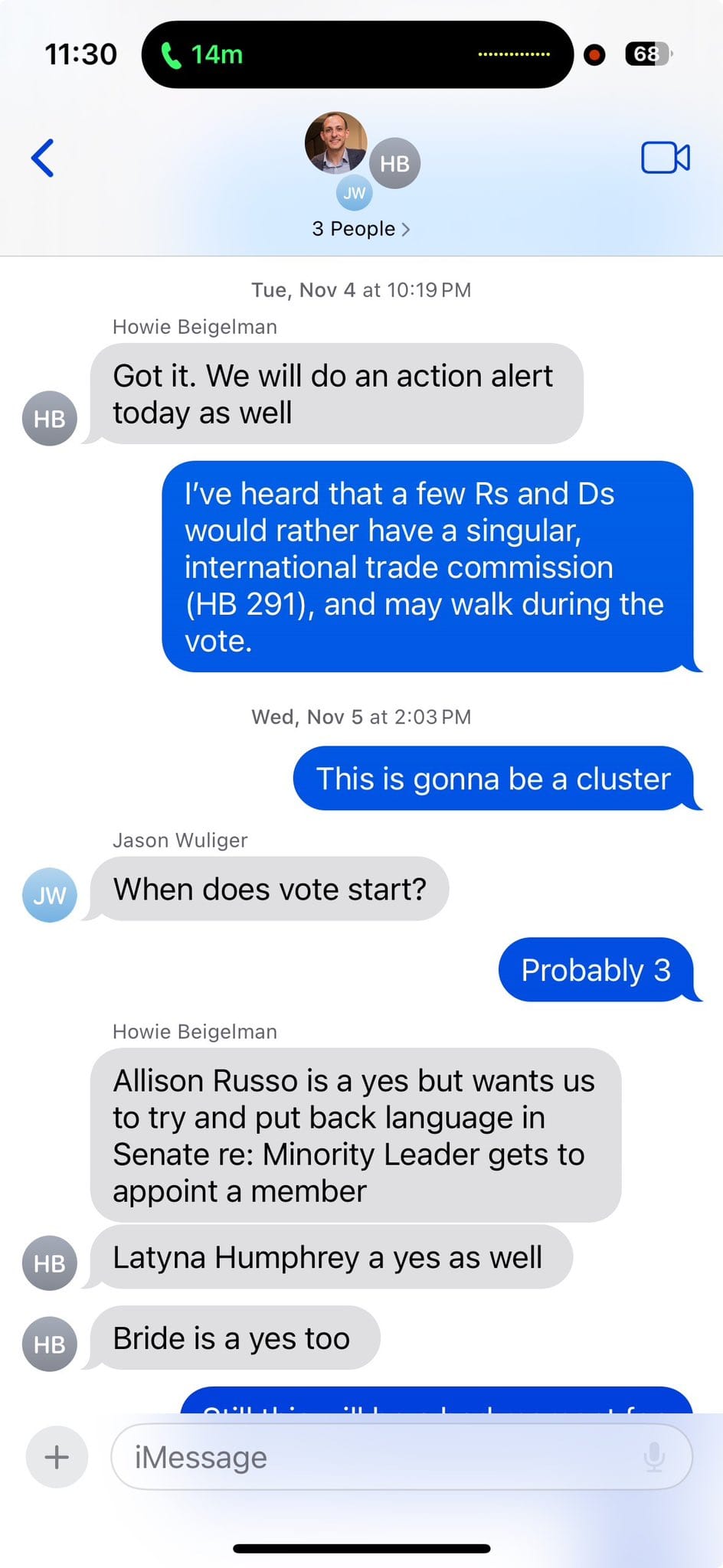
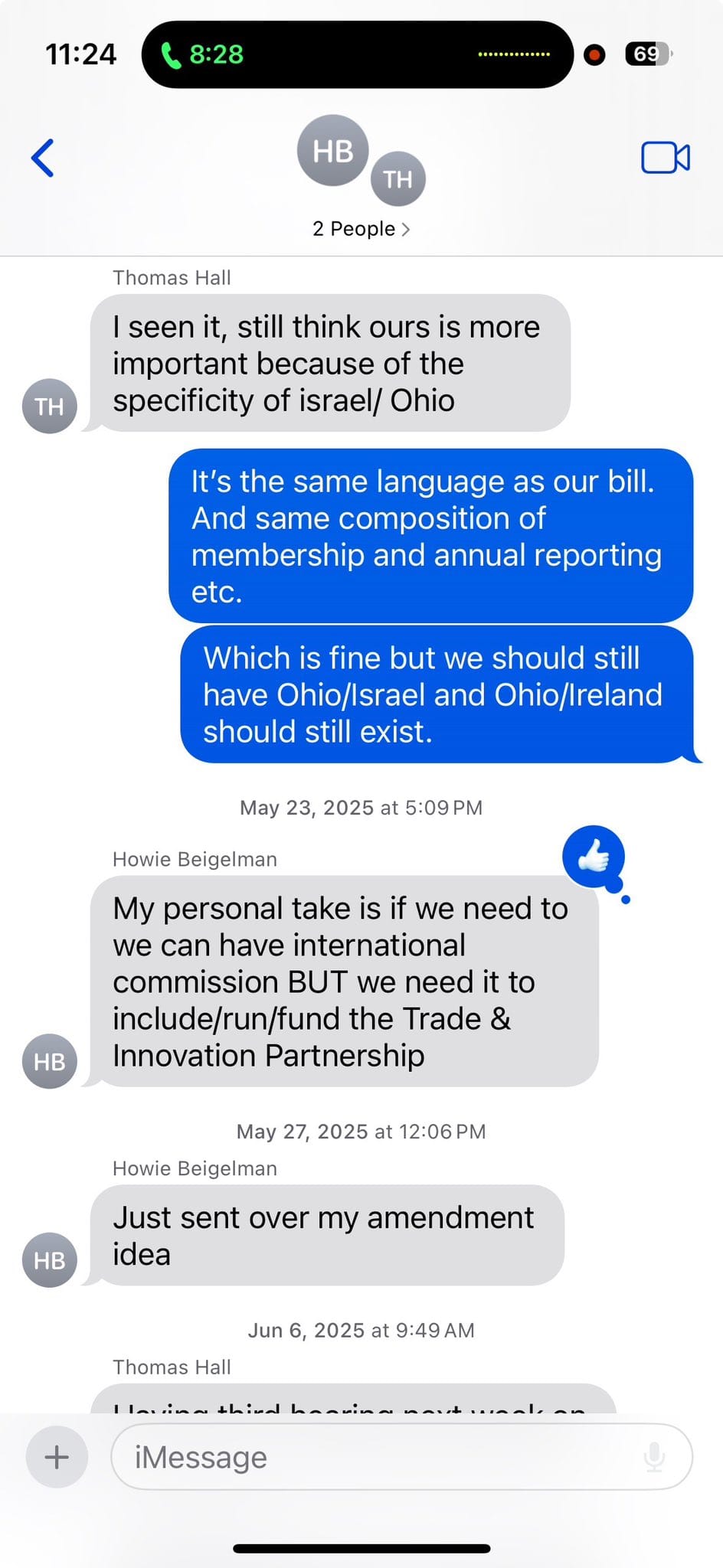
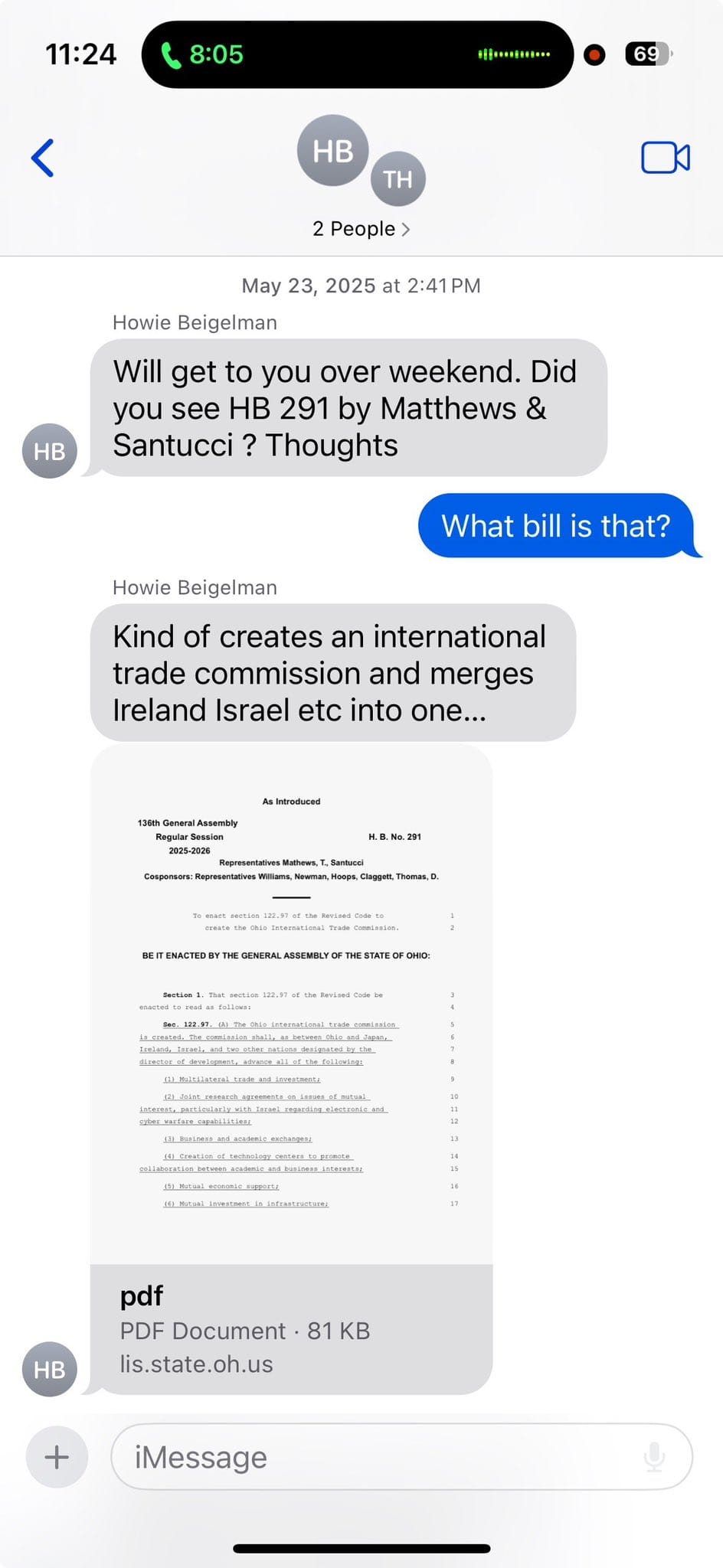
Text messages from May through November 2025 involving Hall, Synenberg and Howie Beigelman, then-CEO of Ohio Jewish Communities, show advocates working behind the scenes to preserve HB 188 as a standalone bill after lawmakers amended HB 291 to strip out explicit references to Israel, Ireland and Japan to ensure passing. In May 2025 messages, Beigelman proposed amendment language to ensure any trade structure would fund the partnership, while Hall emphasized keeping a dedicated Ohio-Israel measure.
Economic critics argue that connecting international trade alliances to state workforce development follows a familiar regional playbook. Reporting by citizen journalism outlet The Ohio Register has traced a decade-long link in southwest Ohio between defense-aerospace expansion and municipal "Welcoming" initiatives.
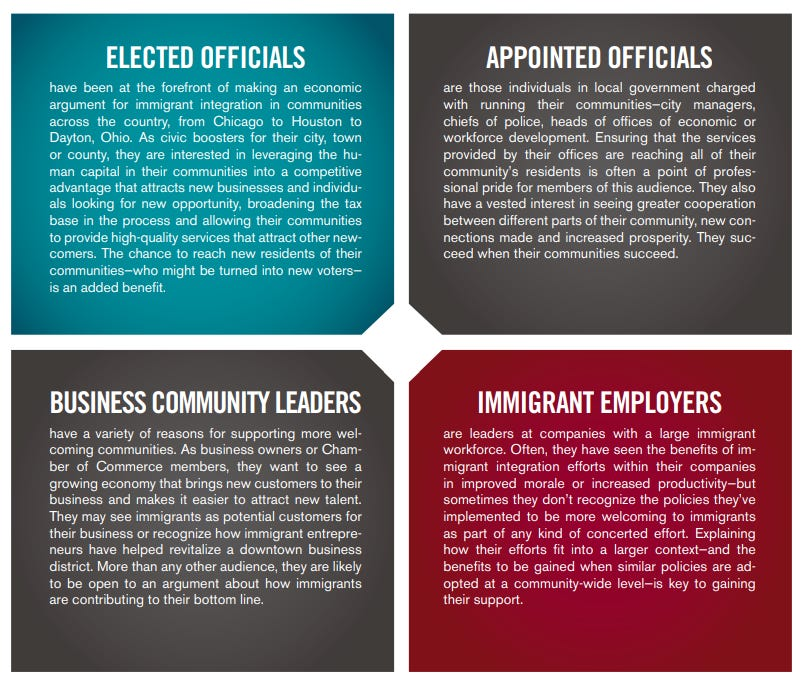
Critics point to the 2010 formation of the Dayton Regional Israel Trade Alliance and subsequent federal aerospace strategies around Wright-Patterson Air Force Base, which coincided with the adoption of the Welcome Dayton and Welcome Springfield initiatives in the early 2010s. Those local programs aimed to revitalize shrinking Rust Belt populations by integrating immigrant workers into regional manufacturing and logistics hubs. Similarly, Findlay is also being positioned to adapt a similar framework that all 50 Welcoming Cities have followed.
Skeptics argue that pairing federal defense and aviation grants with immigrant workforce pipelines has strained municipal budgets and housing in cities like Springfield—which absorbed an estimated 15,000 to 20,000 Haitian migrants in recent years—strained municipal budgets and housing in Springfield while bypassing displaced domestic manufacturing workers. Critics have raised similar questions surrounding hybrid-electric aircraft manufacturer Electra Aero’s planned $1 billion facility at the Springfield-Beckley Municipal Airport.
Specifically, critics point to federal Workforce Innovation and Opportunity Act (WIOA) programs administered by county Job and Family Services boards. Under federal guidelines, noncitizens holding valid Employment Authorization Documents—including pending asylum seekers—are eligible for state-administered Individual Training Accounts. Those vouchers can fund technical tuition at state-approved providers such as Sinclair Community College, which operates the National UAS Training and Certification Center and offers credentials in advanced air mobility and aviation maintenance.
Those workforce anxieties also surfaced during Ohio’s 2026 gubernatorial race, in which Democrat Amy Acton defeated Republican nominee Vivek Ramaswamy on Nov. 3.
Throughout the campaign, populist commentators targeted Ramaswamy over his financial disclosures showing an investment stake in 8VC, a venture capital firm backing autonomous defense contractor Anduril. State officials awarded Anduril more than $830 million in incentives to build its Arsenal-1 manufacturing facility near Rickenbacker International Airport outside Columbus.
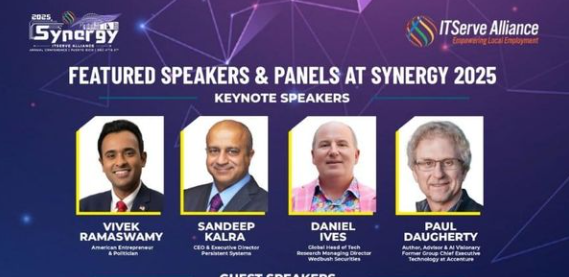
Online critics merged Ramaswamy’s indirect financial tie to Anduril with his past defense of H-1B high-skilled foreign worker visas. That friction boiled over in December 2025, when Ramaswamy canceled a scheduled keynote speech at the ITServe Alliance’s Synergy 2025 conference in Puerto Rico following conservative backlash. ITServe Alliance, a Texas-based trade group representing over 2,200 IT staffing firms, successfully sued U.S. Citizenship and Immigration Services in 2018—resulting in a 2020 settlement that rescinded strict third-party worksite itinerary rules for H-1B visa petitions.
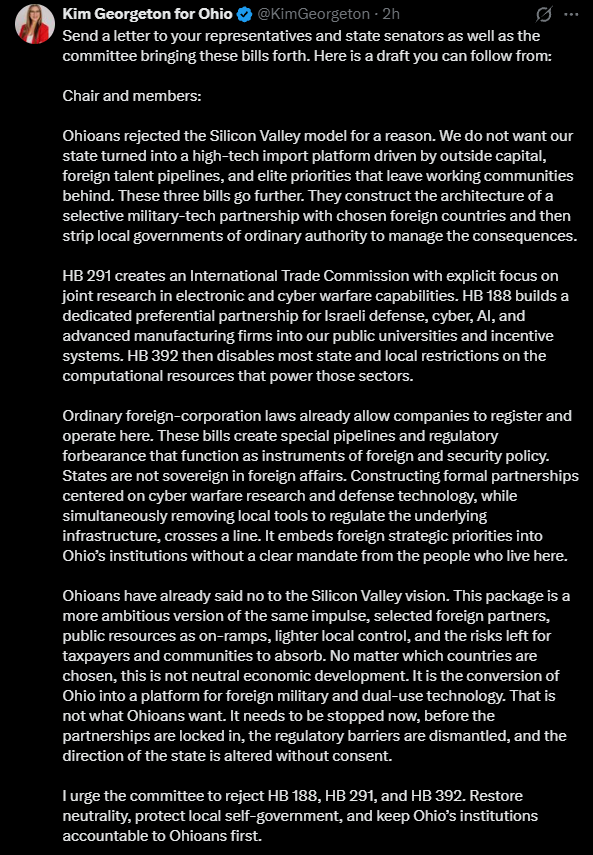
While text of HB 188 contain no foreign-worker quotas or immigration provisions, the pattern is undeniable and nearly impossible to defend against with minimal to no federal enforcement of immigration protections against labor replacement. The bills are being actively opposed by former candidate for Lieutenant governor Kim Georgeton, who issued a call to action to call the Senate Finance Committee members to urge them to block the bills seeking international integration and further technocratic development fueled by international labor pipelines. Georgeton has urged residents to contact Senate Finance Committee members to block HB 188 and HB 291 alongside House Bill 392, the Ohio Right to Compute Act. Georgeton and other critics contend that HB 392—which limits state and local governments from restricting computational resources and artificial intelligence systems—would strip communities of local regulatory tools at the same time the trade bills open public universities and incentive programs to foreign defense and AI firms.
Ladies and gents:
— Kim Georgeton for Ohio (@KimGeorgeton) November 16, 2026
We have a serious issue at hand. Our legislators are trying to turn Ohio into a foreign entanglement.
Ohioans rejected Vivek Ramaswamy’s gubernatorial bid about turning the state into another Silicon Valley—an imported, high-tech, high-cost model driven by…
With the 136th General Assembly scheduled to adjourn at the end of December, Senate Finance Committee leaders face a narrowing lame-duck window to decide whether to advance HB 188 to the Senate floor or let the measure expire before a new administration takes office in January.