Public Private Partnership Gives Update on Springfield 2051 Project, Leading to New Questions
BY JEFF SKINNER
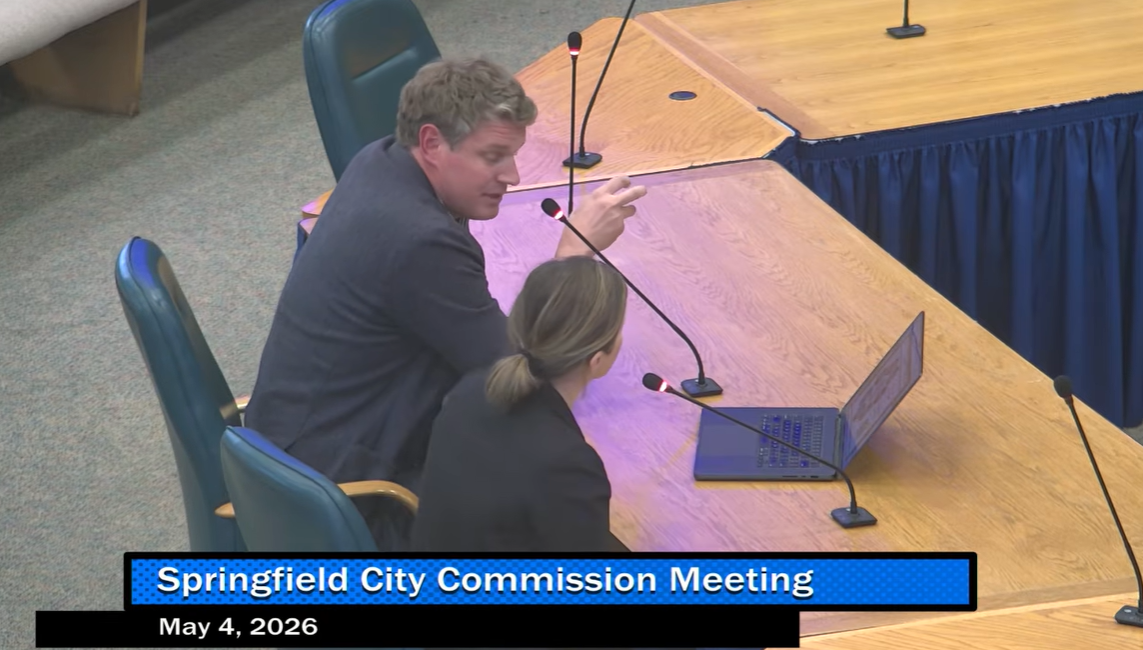
SPRINGFIELD - On Monday, The Springfield commissioners met to hear an update from representatives from the newly minted ‘public-private’ partnership administration for Springfield 2051, a think-tank operation designed to guide city development, facilitated by contracted organization Future IQ.
During the update, representatives Kevin Rose and Marta Wojcik reviewed with the commissioners the 7 key pillars the organization and the steering committee had boiled down from the copious amounts of surveys received from the general public, for which the local government and committee began to develop strategic plans for implementation.
"This is quite a few more pillars than our consultant [Future IQ] is used to using in the community," Rose said. "They like about five of them. So we tried like, well, what could we remove or what could we combine? And ultimately we decided all seven of these were so important in this region that we heard from our citizens, that these were so important that we couldn't merge them with something else that we needed to focus on them."
Readers may remember TOR has previously covered how the facilitator of the operation, Future IQ, the WEF ideologically aligned contractor, develops its action strategies through a proprietary process of scenario planning.
Initially, during the inquiry phase in which Future IQ was receiving surveys, the organization found a vast number of the community interaction to be somewhat negative towards the ‘stakeholders’ desired goals for development of the region. However, after significant effort from the group, it would appear the steering committee for 2051 has, according to the report, boiled down community concerns into 7 key pillars with eyebrow raising implications. According to the report, those pillars are:
Fostering Strong Neighborhoods and community wellbeing, Creating youth opportunities, Activating Southside revitalization, Elevating arts, culture, and heritage, Enhancing downtown and corridors, stimulating strategic economic growth and capitalizing on recreation and natural assets.
The group acknowledged how daunting it was to boil down all of the initial surveys received, which may have illustrated a divergence from some of these initiatives to ‘remove or combine’ them into these 7 pillars.
“Early on in the survey results, as you can imagine, there was a lot of negative responses, and we understand that there's a lot of people who want to see different direction, are affected by things that are going on in the community, and we were getting some of that early on in the survey response,” Kevin Rose said. “But as the survey played out over time, the number of people that were expressing that they were happy about the direction the community's in, and also very excited about the future of this community, kept growing, and growing, and growing.”
During initial reporting over the 2051 project, it was understood, based on available documents from facilitator Future IQ, that much of the initial surveys would be used to gauge public interest and sentiment towards potential preestablished directions from the ‘stakeholders’ in the steering committee. Those initial surveys most likely communicated the kind of opposition the group would be facing. However, over time, after significant roundtable discussions to soften the impact and launching a ‘podcast’, the organization seems to have been able to guide discussion back on track towards the desired outcome of the ‘public-private’ partnerships of nonprofits and economic development ‘stakeholders’ that will be developing policy initiatives for the commissioners moving forward.
Of particular note, was the emphasis for economic development as a key pillar for the group to focus on. This was perceived as especially confusing as Mayor Rob Rue stated in February 2025 due to public concerns over economic replacement from cheaper imported labor through TPS immigration programs that the city has more than enough jobs for everyone that wants them. A contradictory statement if economic development is a key pillar for the citizens of the community. However, introspection into individuals on the steering committee does reveal why economic development would be a priority for their guided discussions.
Future IQ CEO David Beurle has stated that the Springfield 2051 project explicitly looks at how the city fits into the broader "Dayton-to-Columbus" corridor. As Central Ohio transforms into a global tech hub—often called the "Silicon Heartland"—Springfield is positioning itself to be a "bedroom community" or a secondary supply hub for the massive workforce and industrial needs of this corridor, which will primarily focus on imported labor.
Springfield already hosts companies like Silfex, a major producer of silicon components used in chip manufacturing, which anticipates expansion as the Intel facility comes online. The 2051 roadmap aims to identify other ways Springfield can attract "Silicon Heartland", a concept pioneered by Les Wexner, and supported by his two selected candidates for Governor, Vivek Ramaswamy and Amy Acton, to benefit satellite businesses.
In fact, Wexner’s The New Albany development is used as a case study for the Springfield 2051 committee. Key takeaways being studied include: Site Readiness: New Albany’s success was credited to the government's ability to assemble large sites and infrastructure in advance. Local leaders are looking at models like Lorain County Community College to ensure Springfield can supply the "highly coveted" technicians needed for the regional chip industry. The Intel project is a multi-decade buildout (expected to last until 2030 or beyond), which mirrors the 25-year scope of Springfield 2051.
Future IQ’s role is to provide the "scenario-based strategic planning" tools to help Springfield decide if it wants to lean heavily into this tech-centric future or pursue a different economic identity.
Ironically, the Springfield 2051 Steering Committee includes key leaders whose organizations are central to the city's data center expansion, a hot button issue for citizens concerned over air, water and electricity impacts, and the management of its changing workforce. It could be said that the push for data centers in Springfield is led by organizations represented on the steering committee.
- Horton Hobbs (Greater Springfield Partnership): As the VP of Economic Development, Hobbs is the primary recruiter for large-scale tech projects. He oversees the Prime Ohio Corporate Park, the site of a new $1.3 billion data center project by the 5C Group and Vultr.
- Bryan Heck (City Manager): The city government, under Heck's leadership, approved a 50% 10-year tax exemption for the Vultr project. The city also maintains a Data Center FAQ to address resident concerns about energy and water usage.
- John Landess (Turner Foundation): The Turner Foundation has long-standing ties to the Nextedge Applied Research and Technology Park, which was specifically designed for high-performance computing and data modeling.
- Brad Pepper (Topre America): As a senior executive at a major local employer, Pepper represents the industrial base that benefits from the upgraded power and fiber infrastructure required by data centers.
Nationally and in Ohio, data centers have become a massive driver for building trades unions, who are increasingly partnering with tech giants like Google and OpenAI to train thousands of new workers for these projects. Springfield has seen a significant increase in its immigrant population (primarily Haitian) in recent years. Members of the steering committee, such as Dr. Raphael Allen (Springfield Foundation) and Andrea O'Connor (Wilson Sheehan Foundation), represent organizations that fund the social services and "wraparound" support systems managing this rapid demographic change. The Future IQ methodology used for Springfield 2051 includes "Network Mapping Analysis" to visualize how these different labor pools—both local and newcomer—can be integrated into the city's 25-year economic roadmap.
Rose concluded the presentation by attempting to stress a 'grassroots' nature for the project by stating it is not being led by 'government'.
"Last thing I wanna stress, because I think it came up at the last time we did an update, is to stress that this is a non-governmental project, right?" Rose said. "This is not something that is led by the city. It's not being led by the county. It's not being led by the chamber. And I know the chamber's not the government. This is a project that began with two residents, and then was three residents, and then was seven, and 10, and 50, and 100, and now several thousand."
The point is true when looking into the Wexner 'public-private' partnership model. Organizations like those on the steering committee for 2051 often guide and direct policy in the Wexner model, are funded by tax subsidies from the citizenry, but are entirely unaccountable in traditional governmental models as they cannot be 'voted out' of leadership or influential positions despite pushing policy initiatives potentially damaging to the citizenry, whether that be through facilitating replacement migration or pursuing 'economic development' that will degrade air, water and land for heritage residents.