Server logs expose private economic brokers vetting Findlay data center law ahead of public rollout?

BY CAREY MORGAN
FINDLAY - Internal communication logs and email archives surrendered by the City of Findlay have revealed that the executive administration provided private, state-funded economic brokers with early access to potentially 'vet' the city's highly publicized data center zoning framework before it was formally introduced to local taxpayers.
The records, obtained by The Ohio Register via the Ohio Public Records Act, document a high-stakes, 24-hour turnaround where regional development brokers RGP are potentially being utilized as a back-channel reviewing audience for Chapter 1144, the city's pending technology infrastructure legislation.
While the general existence of the data center zoning framework has been a matter of public record since late July, the newly unredacted correspondence exposes the behind-the-scenes mechanics of how the text was handled immediately following its passage by the Findlay Planning and Zoning Committee.
The timeline centers on an active legislative hand-off that occurred between Wednesday, July 22, 2026, and Thursday, July 23, 2026.
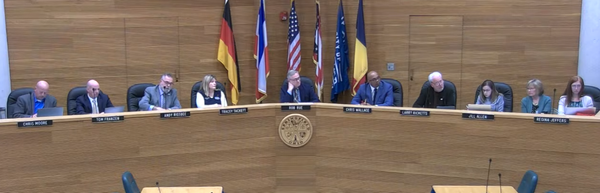
Official meeting transcripts from July 22 show the committee voting to move the draft ordinance forward to the full City Council after making significant, live revisions to the text. These modifications included mandating a uniform 1,000-foot setback from residential zones, implementing a flat blanket ban on groundwater extraction for equipment cooling, and dropping the minimum parcel requirement from 50 acres down to 5 acres to encompass smaller commercial properties.
The sudden structural overhaul of the zoning law immediately triggered an internal administrative debate, the server logs show.
At 5:44 AM on Thursday, July 23—less than 24 hours after the committee adjourned—Findlay official Daniel DeArment sent an urgent email to Mayor Christina Muryn and planning director Matt Cordonnier. DeArment aggressively lobbied against the freshly expanded 1,000-foot setback rule, warning that the heavy footprint required for the buffers would inadvertently consume premium local agricultural resources.
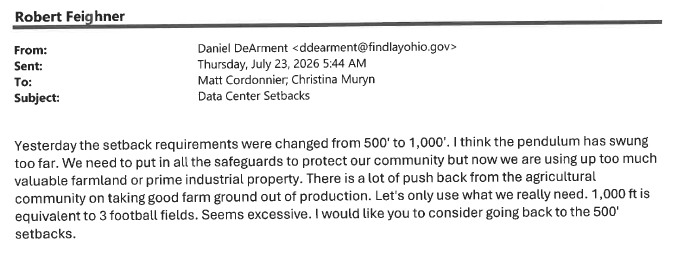
"Now we are using up too much valuable farmland or prime industrial property," DeArment wrote. "There is a lot of push back from the agricultural community on taking good farm ground out of production. Let's only use what we really need.
Six hours later, at 11:15 AM on July 23, Muryn bypassed standard public tracks and transmitted the newly revised "Chapter 1144 Data Center Draft v7" document directly to Gary Thompson, Executive Vice President of the Regional Growth Partnership (RGP). The Toledo-based private non-profit serves as the designated northwest regional network partner for JobsOhio.
"Gary, Please see attached as discussed. Appreciate your feedback," Muryn wrote.
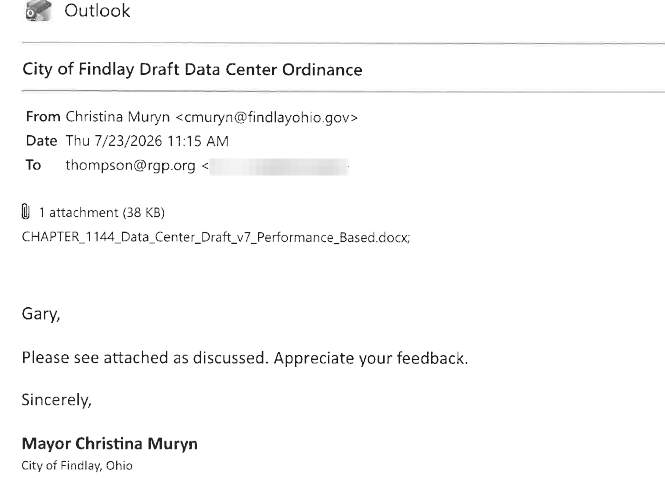
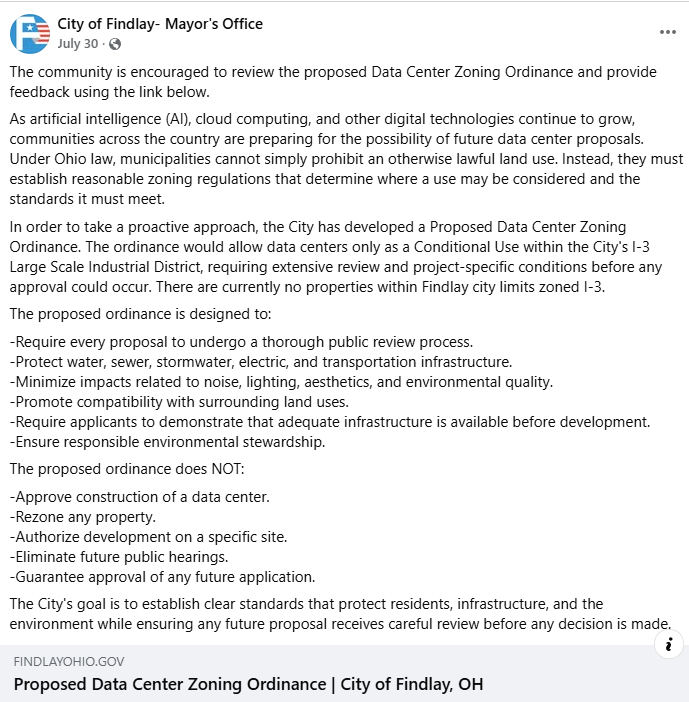
The private transmission occurred exactly one week before the City of Findlay launched its public online information hub to distribute the text to local residents on July 30.
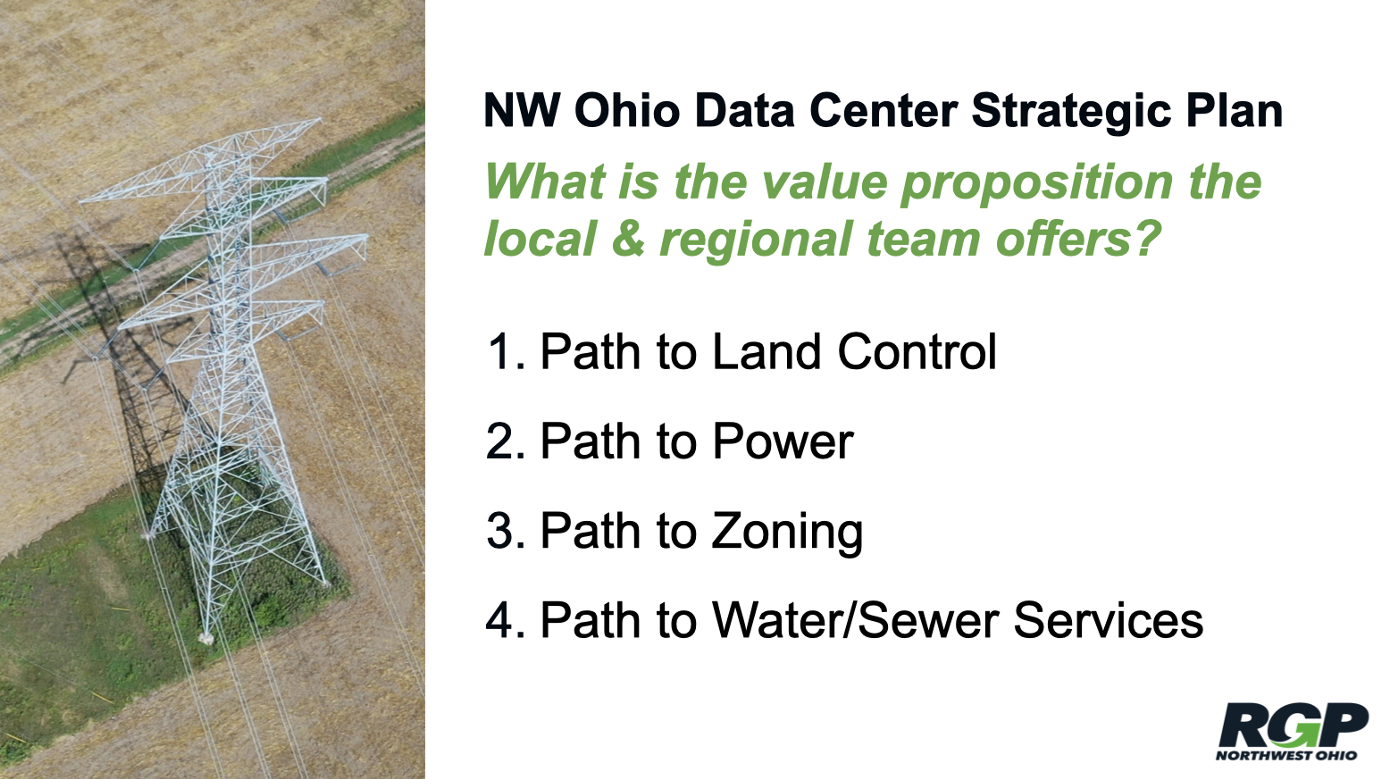
The regional outreach occurs amid a broader push by regional development planners to address localized infrastructure concerns. Presentational materials from the RGP’s 2026 Annual Meeting outline the organization's regional data center strategic plan. The deck includes a slide titled "What is the value proposition the local & regional team offers?", which explicitly lists a "Path to Zoning" alongside paths to land control, power, and utility services as a core component of regional site development.
Open records advocates regularly argue that vetting public legislation through private economic intermediaries ahead of the public record subverts the core intent of municipal transparency. Because private non-profit corporations are shielded from direct public records requests under Ohio law, routing draft municipal codes through external servers creates an insubstantial paper trail that frequently obscures the true authorship of local regulatory policies.
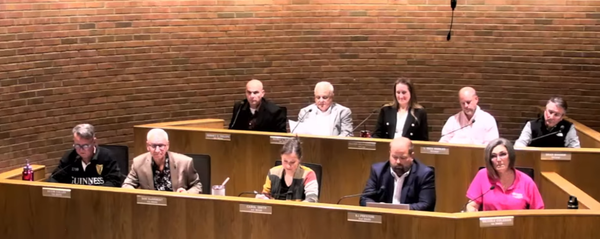
The newly surrendered files also document community members challenging the committee over a specialized analytical report detailing local data center tax revenues compiled by the Hancock County Port Authority. Audience representatives stated on the record that the public authority has been withholding the file from the public pool because "they didn't want to stir things up."
Muryn acknowledged having reviewed the undisclosed report, but downplayed its significance to the audience during the July 22 session, describing it as a "pretty simple analysis" of the city's tax grid structure.
Findlay's active data center construction moratorium remains in effect until April 2027. Under state legislative guidelines, the city cannot wave standard readings or pass permanent zoning text under an emergency clause, meaning the draft ordinance will face multiple public council readings over the autumn session.
Legal experts state that the resulting paper trail effectively demonstrates that while local zoning boards attempt to finalize technology infrastructure rules through public debate, the structural text of local municipal law is frequently shaped by private, state-aligned economic brokers operating well ahead of the public record.