PAPERLESS PROJECT? PERRY VILLAGE CLAIMS NO DOCUMENTS OR IMPACT STUDIES EXIST FOR MULTIMILLION-DOLLAR DATA CENTER DEAL

BY STAFF CONTRIBUTOR
PERRY - Perry Village officials have declared they possess zero written economic impact studies, project descriptions, or internal digital communications regarding a controversial, multimillion-dollar data center project slated for development on local public land.
The admission, delivered via a series of public records responses, has ignited sharp transparency concerns from residents who question how local leaders could advance an $8.4 million real estate transaction and rewrite zoning rules without reviewing basic written due diligence.
The project, spearheaded by California-based real estate firm Province Group and its legal arm Newport Equities LLC, outlines plans to transform 217 acres of the former Champion Farm property into a massive six-building, 1.2-million-square-foot data center campus. Perry Village owns the largest portion of the property, a 163.5-acre parcel that the village agreed to sell to developers for $8,585,000.
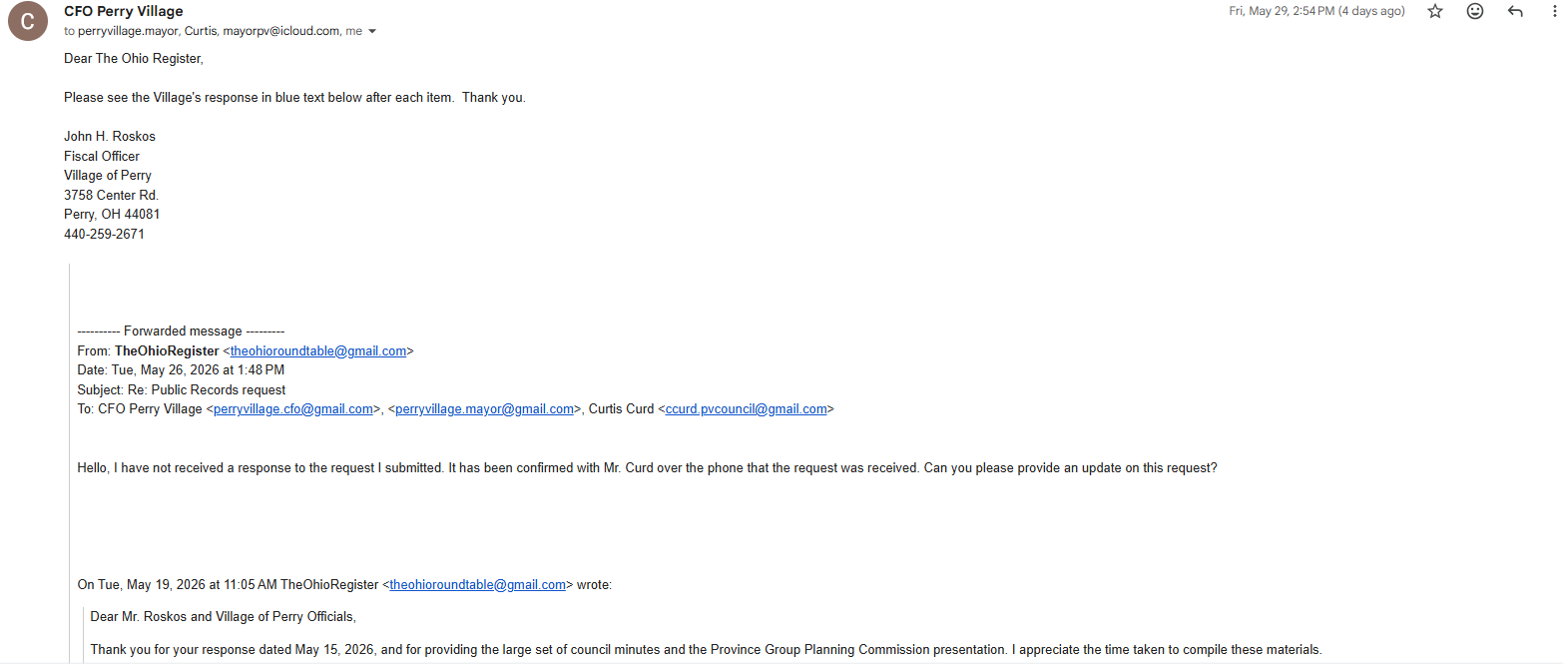
Despite the sheer scale of the proposal, Perry Village Fiscal Officer John H. Roskos officially stated that "no additional records exist" when pressed for technical records, communication logs, or formal economic and infrastructural impacts associated with the deal. It was noted in a previous records request that at least one member of the previous village administration had signed a nondisclosure agreement.
The timeline to secure the public documents has been marked by persistent delays and escalating legal friction under the Ohio Public Records Act (ORC § 149.43).
April 16, 2026: The Ohio Register submitted an initial public records request seeking developer site plans, economic impact evaluations, council authorizations, and all communication logs between village leadership and Province Group agents since the signing of a project non-disclosure agreement in January 2024.
April 17 – May 1, 2026: The village acknowledged the request but repeatedly delayed production, initially projecting a 10-day turnaround before requesting an extension to locate materials.
May 15, 2026: Following an urgent warning by The Ohio Register outlining statutory damages for constructive denial, the village produced a bulk package of past city council minutes and a public presentation from a June 2025 Planning Commission hearing. However, core engineering details, written proposals, and impact studies were entirely missing from the file and unaddressed in email correspondence.
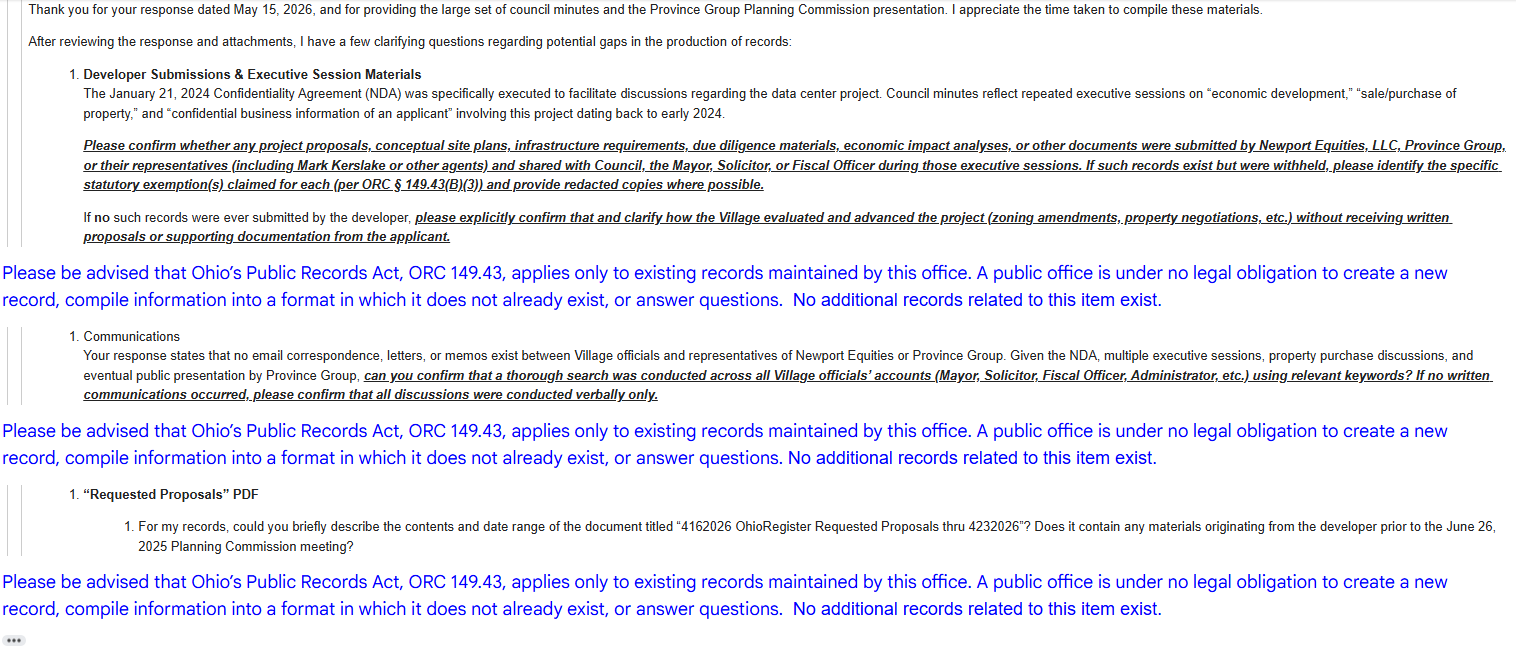
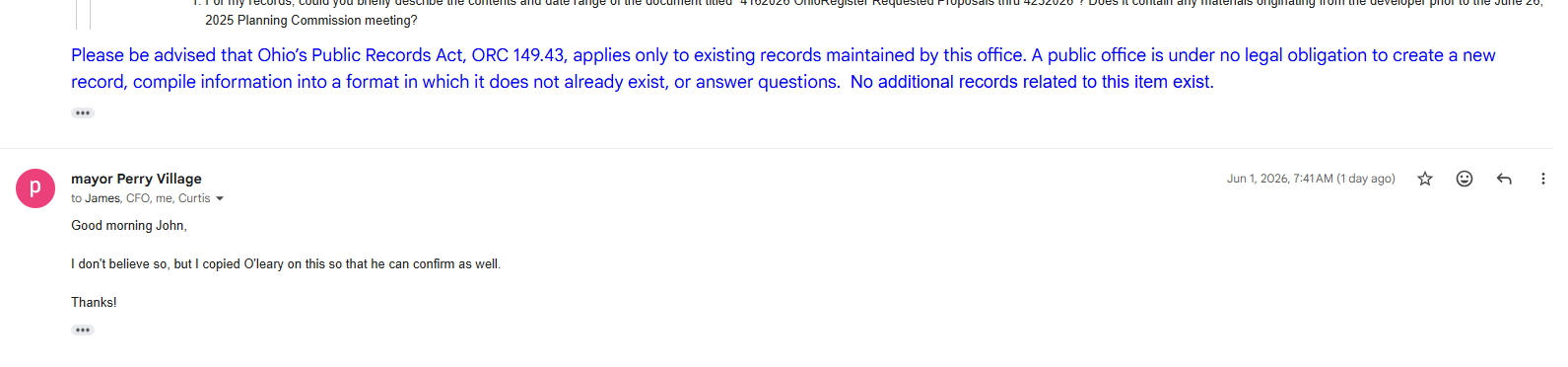
When The Ohio Register pushed for clarification regarding the gaps in information, the fiscal officer issued identical, boilerplate responses under every inquiry: "Please be advised that Ohio’s Public Records Act, ORC 149.43, applies only to existing records maintained by this office... No additional records related to this item exist."
The legal declaration that no further records exist forces an extraordinary conclusion about how local governance has operated behind closed doors.
Because the village insists no supplementary documents exist, it is officially asserting that a project with a 200-megawatt power demand—far exceeding the local residential grid—was fast-tracked through multiple closed-door executive sessions with zero written analyses regarding traffic, noise, grid reliability, or taxation.
Furthermore, the village denied the existence of any emails, text messages, or memos between public officials and the developer, meaning all coordination for the multi-million-dollar purchase was allegedly conducted through unrecorded, verbal-only interactions.
Internal alignment on the matter also appeared fractured. In a June 1 internal email chain forwarded along with the response, an unnamed individual under the Perry Village Mayor Email account cast doubt on whether a comprehensive search had actually occurred, writing to council members, "I don't believe so, but I copied O'Leary on this so that he can confirm as well," before handing the matter back to legal review.
It has been reported previously that Former Mayor James Gessic abruptly resigned from his post as mayor on May 14 during a time of mounting community scrutiny over the lack of transparency surrounding the project.
The public records disclosure comes as grassroots opposition intensifies across Northeast Ohio. Local advocacy groups, including Conserve Ohio, have packed village hall meetings to decry the lack of community visibility, pointing to severe environmental concerns, noise pollution from industrial cooling units, and massive water usage from shared aquifers.
Similar data center pushbacks have triggered emergency municipal moratoriums in neighboring Painesville Township and Madison Township as communities scramble to modernize zoning rules for hyperscale computing facilities.
The Ohio Register is currently evaluating its legal options, which may include filing a formal complaint with the Ohio Court of Claims to compel a forensic review of the village’s servers and verify if records have been unlawfully withheld.
The two documents provided to TOR, which include two short power point presentations and allegedly formed the basis of their initial response outside of public meeting minutes, have been included below for public download and review.