Findlay Works with Local Zoning Toolkit to Make Data Center Development Difficult, Can It Work?
BY CAREY MORGAN
FINDLAY - Facing a tight regulatory timeline under an active 12-month emergency moratorium, the Findlay Planning and Zoning Committee is scrambling to rewrite its industrial code to manage a looming wave of potential data center development. However, while local lawmakers are focused on micro-managing physical plot parameters, their proposed rules may prove entirely fruitless in shielding residents from regional water depletion, grid inflation, and environmental degradation.
The rush to craft a new "I-3 Large-Scale Industrial District" follows a major shift in the city's narrative. Initially, some council members argued that because data centers were completely unmentioned in the city's code, they were already functionally banned. The city administration quickly debunked that notion, warning that a missing definition is merely a "procedural gap" rather than a legally defensible permanent ban under Ohio law. To prevent tech conglomerates from exploiting this vacancy, the committee has been forced to design a highly localized "Conditional Use" framework.
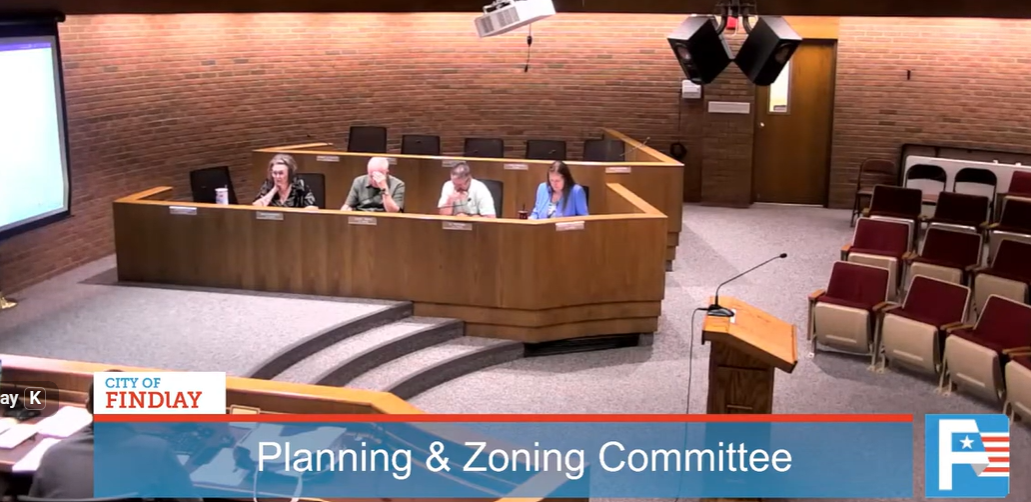
The committee's strategy relies on dictating how a facility affects its immediate physical surroundings. During the zoning committee session on July 15, city planners emphasized that data centers will not be permitted "by right" anywhere in Findlay; developers must first successfully clear a rigorous conditional review.
A major block of the debate centered on tightening property-line noise controls. The original code draft mandated a 55-decibel cap between 7:00 a.m. and 10:00 p.m. measured at the property line of any residential district. Administrators moved to heavily alter this language to force self-containment.
When committee member Danny DeLong questioned if property-line decibel limits were practically enforceable or standard, city administrators defended the text by pointing out the city's historical zoning successes in enforcing these codes with car washing businesses that run louder vaccuum cleaning devises.
Water management also drew significant scrutiny. Addressing Section H of the draft zoning code regarding groundwater withdrawal, committee members asked, "Can we write it in that it's not allowed if they're in our water system?". Staff clarified that while groundwater clearing is a standard necessity during construction foundation pours, the restrictive zoning language was actually aiming to monitor long-term "geothermal cooling purposes."
Furthermore, the committee pushed for aggressive enforcement mechanisms on detention basins. Noting that several local subdivisions have had storm ponds fall into complete disrepair after homeowners associations dissolved, members demanded strict penalties, asking for "verbiage in here because we're getting a lot of retention ponds... and how we enforce the maintenance of them." The committee asked for an annual reporting process to ensure compliance.
Ultimately, the committee voted unanimously to postpone recommending the draft to the full City Council. As one member concluded, "I'm not comfortable recommending that it go forward to city council without having all of the language in it yet," tabling the document until a mid-summer workshop can finalize the text.
While Findlay’s committee is focusing its energy on fence placements, pond maintenance, and drone-style buffer zones, energy data and macro-level legal structures indicate these local mechanics are fundamentally powerless against the industry's true threats.
The most glaring vulnerability in Findlay's defense is its total lack of utility jurisdiction. Because Findlay does not operate a municipal electric utility, developers negotiate directly with massive transmission providers like AEP Ohio or the Hancock-Wood Electric Cooperative.
When a multi-megawatt data center attaches to the high-voltage regional grid, it requires hundreds of millions of dollars in localized grid infrastructure upgrades, sub-stations, and high-voltage line expansions. Under standard regulatory mechanics overseen by the Public Utilities Commission of Ohio (PUCO), private transmission companies routinely recoup these massive capital buildout costs by distributing them across their entire residential customer base. No amount of local I-3 zoning setbacks can legally dictate a utility company's billing structure or prevent regional residents from facing sudden, dramatic electricity rate hikes.
During the hearing, some members expressed relief under the assumption that newer industrial facilities operate as completely self-contained entities. One member stated, "The newer ones now... it's a closed loop manufacturing process. They generate their own electricity... and it's a closed loop for all the water as well... They recirculate their own water."
Environmental engineers and utility watchdogs note that true zero-impact closed-loop scaling is an industrial myth. While closed systems do eliminate the continuous, massive evaporative loss seen in open-air cooling towers, they require intensive, highly toxic chemical flushes during initial construction and scheduled maintenance cycles. These heavy episodic wastewater dumps—saturated with anti-corrosive agents and biocides—are discharged directly into municipal water treatment lines, threatening public infrastructure. More critically, closed-loop facilities require exponentially higher volumes of continuous electricity to power their massive arrays of air-chilling compressors. This shifts the water consumption footprint off-site to regional fossil-fuel power plants, which draw millions of gallons of groundwater daily from the shared regional aquifer to generate the data center's baseline power.
Local ordinances additionally completely lacks the power to police localized air pollution. To maintain strict corporate uptime requirements, data centers house rows of industrial diesel backup generators capable of producing massive localized emissions during grid strains. Because stationary source emissions are strictly regulated at the federal level via the Clean Air Act and managed by the Ohio EPA, which cureently seems accomodating of air and water quality degredation, a municipal zoning board cannot legally bar an approved industrial facility from running its emergency generators, regardless of residential proximity.
Some argue as well geographically, the city's entire zoning strategy can be completely bypassed. City planners openly conceded during the regulatory process that actual data center construction will most likely take place on cheap agricultural plots completely outside city limits.
If a technology firm purchases a large tract of unzoned land in unincorporated Hancock County, Findlay's I-3 ordinances are completely useless. The facility can build right up against residential borders, tap the shared water table, and exhaust the local energy grid with zero municipal oversight. The developer can then simply apply for municipal annexation down the road to secure city utility access, leaving Findlay residents with 100% of the localized infrastructure degradation and 0% of the zoning protection.
The current stategy seems to be to make the purchase of a parcel potentially inhospitable to developers through zoning penalities, one of the few areas municipalities can control. Though it is unclear how successful these could be. With municipalities running into hard legal boundaries, some are arguing true public protection may be shifting entirely toward state-level regulatory reform. Lawmakers at the Ohio Statehouse have introduced comprehensive legislation, including Ohio House Bill 706, which explicitly targets the loopholes local zoning cannot touch. If passed, H.B. 706 would legally prohibit electric distribution companies from shifting data center grid expansion costs onto residential customer classes. It would also strip away lucrative state sales-tax exemptions and mandate independent Ohio EPA water monitoring programs, should the regulatory agency return to its purpose.