
Springfield Commission Forces 4-1 Reinstatement of City Manager, Confronts Public Anxiety Over Recovery Housing and Data Centers
BY JEFF SKINNER
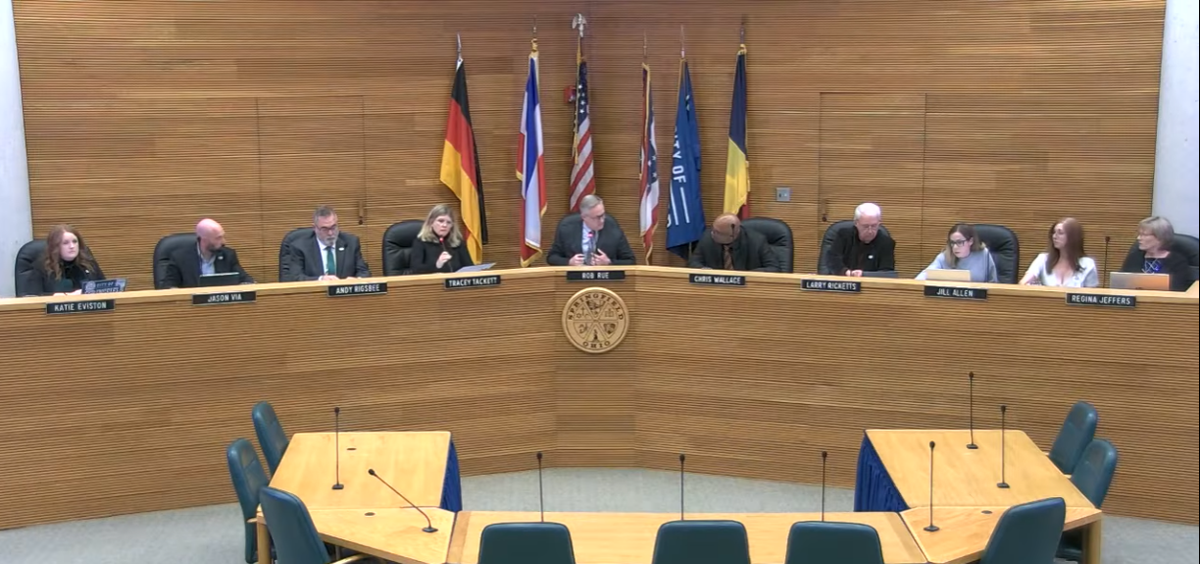
SPRINGFIELD - The Springfield City Commission voted 4-1 Tuesday night to immediately reinstate City Manager Bryan Heck from paid administrative leave, punctuating a tense, hours-long meeting dominated by fierce public pushback, administrative fractures, and deep-seated neighborhood anxieties.
The decision to restore Heck to the city’s top administrative post follows a grueling 10-week investigation by the Ohio Bureau of Criminal Investigation (BCI). While a majority of the commission claimed the BCI's findings cleared Heck of criminal activity and necessitated his return to restore stability, the lone dissenting vote and impassioned testimony from local citizens exposed, once again, a fractured governing body grappling with a severe deficit of public trust.
The reinstatement vote served as the focal point of a meeting that also featured contentious public hearings regarding the uncoordinated explosion of local substance-abuse recovery housing and the hidden environmental strains of rapid data center development across the state.
The motion to conclude Heck’s administrative leave ignited immediate friction among the commission. Mayor Rob Rue strongly championed Heck’s return, arguing that the city could no longer afford to delay business while spending taxpayer dollars on paid leave.
"At a time when the city needs stability, I believe returning him to work is the right decision," Rue said, adding that the BCI investigation had concluded without yielding any criminal basis to block his return.
Rue further directed the city's law and personnel departments to review and update Heck’s employment agreement to reflect what the manager and his family endured over the last two and a half months. Commissioners Chris Wallace, Larry Ricketts, and Andy Rigsbee echoed the mayor's calls for "due process" and professional finality. Wallace dismissed systemic rumors circulating on social media, calling them baseless fabrications that run contrary to Heck's record of professional honor.
Assistant Mayor Tracey Tackett broke ranks, casting the sole "no" vote. Tackett explicitly warned her colleagues that reinstating Heck was dangerously premature, noting that a separate, independent administrative review remained active.
"The independent review is not complete, and the attorney conducting it has advised us to wait until it's finished," Tackett stated bluntly. "I believe we need to let the process run its course before making this decision. My vote is about protecting the city, its residents, and the integrity of the process."
Public comments underscored Tackett's hesitation. Resident Gary Armstrong leveled harsh, personal allegations against Heck from the podium, characterizing him as fundamentally dishonest. Armstrong alleged that Heck had previously misled the public regarding complex hotel deals and localized initiatives for unhoused populations.
"I wouldn't hire him if I ran a Dairy Queen," Armstrong said. "I'm not into anybody that can't be honest, because if I tell you a lie, I don't respect you. If you lie to me, you don't respect me."
Despite the public outrage, the commission's 4-1 majority successfully forced Heck's immediate return.
Beyond the leadership crisis, the commission faced warnings regarding Springfield's changing residential landscape. Kaylee Lawrence, a member of the local Board of Zoning Appeals, stepped forward to testify about a sharp, uncoordinated influx of group recovery housing centers operating within low-density neighborhoods.
According to Lawrence, the rapid proliferation of substance-abuse and behavioral health housing is being aggressively fueled by a heavy influx of federal funding derived from recent, large-scale national opioid litigation settlements. However, she warned that external real estate investors are actively exploiting systemic gaps between state-level certification timelines and municipal zoning laws.
"It has seemed to me that the zoning comes after the operations have started," Lawrence testified. She detailed an alarming trend where private investors purchase single-family homes, lease them out to corporate recovery networks, launch operations under state-level accreditation, and only request city zoning variances after neighbors notice the conversion.
Lawrence revealed that the Board of Zoning Appeals has faced immense difficulty parsing out local regulatory boundaries when confronting operators. She strongly urged the commission, the city manager’s office, and the mental health recovery board to enact an immediate, coordinated policy review. Lawrence further suggested exploring a temporary local moratorium on new recovery housing variances, noting that the Governor of Ohio and the Department of Behavioral Health had already signaled a pause on fresh certifications to evaluate statewide standards.
"We obviously need recovery options in our community, but we need safe and responsible housing," Lawrence argued, calling for a balance between necessary clinical services and reasonable protection for local neighborhood infrastructure.
The evening's testimony took a broader environmental turn when resident Nicole Bethel presented findings directly challenging Ohio's rapid, unchecked adoption of heavy data center facilities.
Bethel presented preliminary findings from a data center advisory committee compiled in Oregon, contrasting that state's 98 active centers with the massive 200 operational data centers currently localized across Ohio. Her presentation outlined a severe "energy-water nexus" trade-off inherent to high-tech operations.
Bethel explained that while advanced data centers utilize modern "closed-loop" cooling techniques to cut down on raw water waste, these systems place a massive, direct strain on local electrical grids. Conversely, standard water-based cooling approaches generate localized ecological emergencies.
"Data centers consume less water annually than agriculture on a statewide scale, but they create intense local stress by coinciding with peak farming irrigation during extreme heat waves," Bethel warned. She added that during winter months, data centers maintain a heavy, uninterrupted water draw that fundamentally blocks natural underground aquifer recharges.
Bethel soundly rebuked Ohio's leadership for offering "overgenerous" property and income tax abatements to massive technology conglomerates while hiding behind aggressive Non-Disclosure Agreements (NDAs) that intentionally isolate everyday taxpayers from the planning process. She noted that the lack of municipal oversight has forced ordinary citizens to organize independently, revealing that local volunteers are actively forming an independent data center advisory committee to bypass state-level inaction.
The commission offered no active debate or policy commitments in response to Bethel's presentation. Lawmakers briefly thanked her for compiling the research to "keep the conversation going" before promptly advancing the legislative agenda.