Findlay Council Stalls on AI Transparency and Data Center Zoning While Moving to Extend Vape Retail Ban
BY CAREY MORGAN
FINDLAY - Findlay City Council adjourned its Nov. 17 regular session in just over 30 minutes without taking a single legislative vote on artificial intelligence governance or data center zoning, leaving high-stakes infrastructure and technology regulations in limbo as the calendar year narrows. While council members swiftly suspended statutory rules to pass emergency appropriations for local equipment, bridge underpass grants, and public art reimbursements, substantive action on two of the region’s most contentious policy issues—civic AI transparency and data center land-use rules—was either absent from the docket or deferred to future administrative meetings.
The omissions occur at a critical juncture for Findlay’s regulatory timeline. With regular council meetings scheduled for the first and third Tuesdays of each month, council has potentially only two remaining regular sessions in 2026—Dec. 1 and Dec. 15—to introduce, debate, and advance data center zoning frameworks before the end of the year. Under standard municipal procedure requiring three separate readings unless emergency rules are invoked, any zoning ordinance not introduced at the Dec. 1 meeting faces a near-certain delay into 2027, compressing the window ahead of the city’s existing 12-month data center moratorium that expires in April 2027.
During Tuesday’s meeting, data centers surfaced only briefly during the Planning and Zoning Committee report delivered by Chairwoman Heather Kensinger, R-at-large. Reviewing the committee’s Nov. 12 session, Kensinger reported that the panel voted to forward a proposed data center zoning ordinance to full council with a requirement for facility decommissioning, incorporating language adjustments discussed during that committee meeting. Kensinger also noted an administrative irregularity regarding the committee’s documentation, explaining that the version included in the council packet lacked the signature of Fifth Ward Councilman Kevin J. Cullen. According to Kensinger, the item had been brought back up as old business during the committee session, requiring staff to print the document after the fact and gather signatures from committee members later that afternoon. Council voted to acknowledge the committee report without floor debate on the substance of the zoning code, the environmental or grid impacts of hyperscale facilities, or how the rules will be enforced.
The lack of legislative action carries immediate implications for industrial expansion along Findlay’s northern border, particularly in neighboring Allen Township. Earlier this autumn, Allen Township trustees approved data center zoning regulations limiting facilities to I-2 industrial districts with 1,250-foot residential setbacks, while carving out an exemption for Planned Unit Developments that allows developer OnSite Partners and its subsidiary One Power to advance a massive proposed data center campus. Because large-scale data center developments in the township frequently rely on municipal utility extensions or face potential annexation into Findlay city limits, Findlay’s failure to finalize its own zoning standards leaves a regulatory vacuum. Currently, Findlay’s proposed zoning framework restricts data centers to a Conditional Use within an I-3 Large Scale Industrial District—a classification that presently contains zero parcels within city limits. Without an adopted ordinance on the books, any annexation petition or utility agreement tied to the Allen Township corridor proceeds without finalized municipal guardrails governing water consumption, noise abatement, or decommissioning bonds.
Artificial intelligence governance received even less legislative traction during the Nov. 17 session. Following council’s Oct. 20 vote to purge Ordinance 2026-119—the Municipal Artificial Intelligence Civic Transparency and Accountability Ordinance—from its legislative agenda without debate, no public-facing AI transparency measure was reintroduced Tuesday. Instead, AI was raised solely under new business when a council member requested scheduling a Strategic Planning Committee meeting for Dec. 8 at 4 p.m. to review an internal AI policy for city employees. By routing AI oversight into an administrative employee policy discussion rather than a binding municipal ordinance, council bypassed public-facing protections regarding algorithmic decision-making, vendor disclosures, and citizen notification in municipal operations.
The deliberate, accommodative posture toward emerging tech and data center infrastructure stood in sharp contrast to council’s handling of local retail businesses during the same meeting. Under new business, council members addressed the impending expiration of the city’s one-year moratorium on new vape, smoke, and hemp retailers, which was originally enacted on Nov. 18, 2025, following a law enforcement raid at a Tiffin Avenue shop. Although the Planning and Zoning Committee voted Nov. 12 to recommend permanent regulations requiring annual city licenses that expire at the end of each calendar year, the legislation had not yet reached council’s floor for a first reading.
Recognizing that permanent legislation requires three full readings followed by a standard 30-day waiting period, council members and Law Director Robert E. Feighner Jr. moved to prevent any gap in the prohibition. Feighner confirmed that his office will prepare an emergency ordinance for the Dec. 1 meeting to extend the retail moratorium for an additional 90 days, allowing council to suspend statutory rules and pass the ban immediately.
The diverging regulatory approaches highlight a pronounced policy asymmetry at City Hall. For data centers, the city’s official policy statements emphasize that under Ohio zoning law, municipalities cannot issue a blanket denial of a lawful business category and must instead craft reasonable zoning standards to welcome responsible economic development. Consequently, city officials have spent months collaborating with industry stakeholders to design a pathway for data centers to enter the local economy. Conversely, for vape, smoke, and hemp retailers—an entire category of state-legal retail commerce—the city has utilized consecutive emergency moratoria to enforce a total ban on new market entrants for over a year, extending the prohibition without presenting empirical data on broader industry non-compliance beyond isolated enforcement actions. While data centers are treated as a presumptively lawful industry entitled to tailored zoning accommodation, lawful retail storefronts remain barred from operating within city limits through rolling administrative pauses.
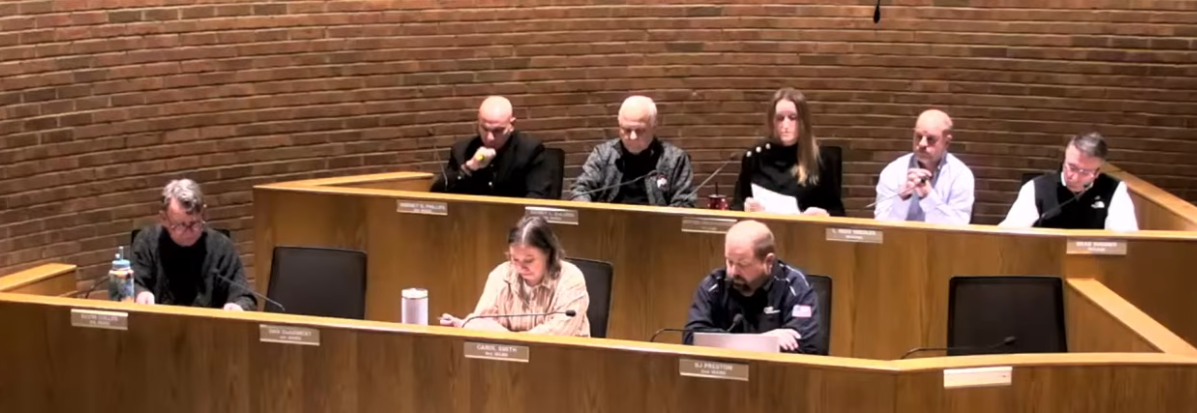
Elsewhere on the Nov. 17 agenda, council’s willingness to utilize emergency legislative powers was on full display for routine municipal spending. With Council President David Murphy presiding and Fourth Ward Councilman Dan DeArment excused from attendance, the remaining eight members—First Ward Councilwoman Nichole Coleman, Second Ward Councilman BJ Preston, Third Ward Councilwoman Carol Smith, Fifth Ward Councilman Kevin J. Cullen, Sixth Ward Councilman Rodney Phillips, Seventh Ward Councilman Danny DeLong, and At-Large Council members Heather Kensinger, L. Reed Needles, and Brad Wagner—unanimously approved Resolution 043-2026 to authorize payment of auditor vouchers exceeding $3,000 incurred without prior purchase orders. Council also gave final third-reading approval to Ordinance 2026-117, accepting the 41.366-acre Huffman annexation in Allen Township, and Ordinance 2026-118, authorizing municipal bidding and contracts.
Under emergency legislation, council suspended the three-reading rule to immediately adopt Ordinance 2026-129 for municipal equipment appropriations, and Ordinance 2026-130, authorizing Mayor Christina Muryn, Safety-Service Director Robert Martin, and City Engineer Jeremy Kalb to apply for Ohio Department of Transportation Alternatives Program funds for lighting and flood-mitigation upgrades at the Blanchard Greenway Trail underpass. Council also suspended rules to pass Ordinance 2026-131, accepting a $5,075 distribution from the Findlay-Hancock County Community Foundation to reimburse muralist Dave Rickerd of RickerdART for mural supplies and design work on the downtown America 250 Veterans Mural Project after Phillips explained that project timelines had outpaced private fundraising.
Before adjourning, council members briefly debated daytime traffic disruptions caused by oversized wind turbine components traveling through city streets and executing U-turns on Interstate 75, though Martin and Cullen noted that state-permitted loads escorted by the Ohio State Patrol fall outside municipal traffic jurisdiction. Clerk of Council Denise DeVore recorded no public speaking requests, and no members of the public signed up to address council during the session