
Trump Executive Order on Vaccines; A Shot In The Arm For MAHA
BY JEFF SKINNER
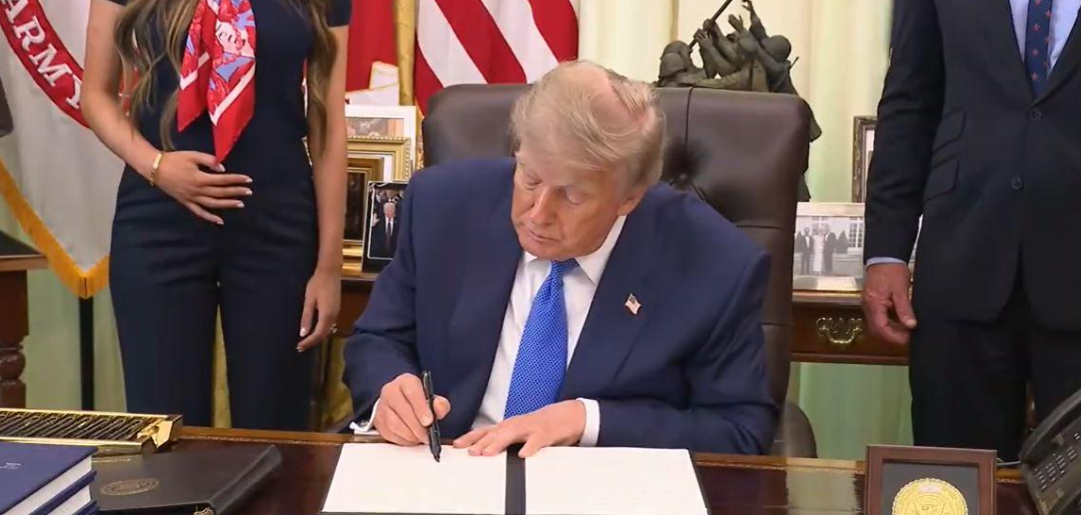
STATEWIDE - President Donald J. Trump on Monday signed a sweeping executive order restructuring the national childhood immunization framework, expanding upon his administration's previous efforts to reduce vaccine mandates by adding aggressive new directives aimed at splitting combination shots and punishing states with strict school-entry requirements and potentially providing an invigorating 'shot in the arm' for MAHA followers.
The order, titled "Delivering Gold-Standard Childhood Vaccine Recommendations for Americans," leaves intact the administration’s core baseline policy to reduce the universally recommended childhood immunization schedule from 18 targeted diseases down to 11. However, administration officials and legal experts noted the new directive goes significantly further than previous administrative actions taken earlier this year by Health and Human Services Secretary Robert F. Kennedy Jr.
Where previous attempts focused primarily on which diseases should be targeted, Monday's order introduces explicit new operational mandates for pediatricians, alters the physical delivery of injections, and structures the federal schedule into a rigid, three-tiered classification system.
The most significant policy departure from previous directives is a new, explicit federal mandate to break up combination vaccines, beginning with the Measles, Mumps, and Rubella (MMR) shot.
Under the previous framework introduced in January, the MMR vaccine remained on the universally recommended list as a singular product. The new executive order reverses this approach, directing federal agencies to transition to single-disease, single-antigen alternatives.
The directive contains an implementation caveat, ordering the transition to take effect "once such products are domestically available." Public health officials quickly noted that single-antigen shots for measles, mumps, and rubella are not currently licensed by the Food and Drug Administration or manufactured by pharmaceutical firms in the United States.
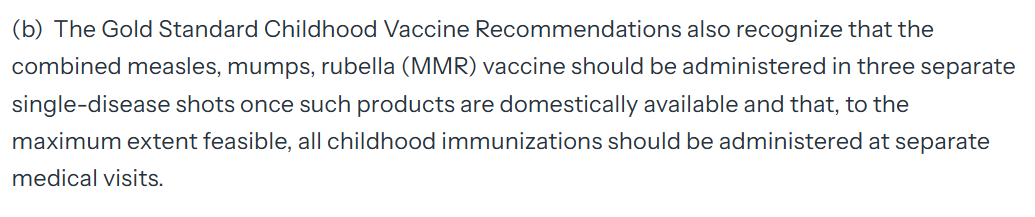
In addition to splitting combination formulas, the executive order adds an entirely new logistical recommendation to space out pediatric vaccine doses across multiple, individual doctor appointments.
Previous administrative guidelines did not explicitly regulate the timing or combination of injections delivered during a single visit. The new order establishes a formal preference for staggered schedules, arguing that reducing the total volume of antigens administered to an infant at any single point in time will maximize safety.
Medical groups, including the American Academy of Pediatrics, immediately criticized the change. Pediatric experts warned that eliminating combination formulas and requiring separate appointments will inadvertently increase the total number of physical needle sticks an infant receives, while creating significant logistical burdens for working parents who must schedule additional clinic visits.
However, organizations such as the American Academy of Pediatrics have historically supported unscientific and pseudoscientific practices, such as gender-affirming care in adolescences and mentally ill individuals as practices by groups like World Professional Association of Transgender Health, or WPATH and have historically ignored data indicating the MMR vaccine has a higher lethality than the virus itself.
The executive order replaces the administration's previous binary classification system—which simply sorted vaccines into "core" or "removed" categories—with a formalized, three-tier risk structure. Under Tier 1, which represents the universal core, eleven diseases remain under a universal recommendation for all children, including measles, mumps, rubella, polio, varicella, and human papillomavirus (HPV). Tier 2 officially removes vaccines for Respiratory Syncytial Virus (RSV), dengue, and meningococcal diseases from the universal schedule, restricting them strictly to children categorized as high-risk. Finally, Tier 3 entirely reclassifies immunizations for Hepatitis A, Hepatitis B, Rotavirus, annual influenza, and COVID-19 under a shared clinical decision-making model. Within this third tier, doctors may only administer these five vaccines if parents specifically consult with their physician and proactively opt in to receive them.
The final and most distinct shift from previous actions is the introduction of an aggressive legal strategy to enforce compliance at the state level.Earlier policy updates from HHS served primarily as non-binding federal recommendations, which many states chose to ignore while maintaining their own independent school-entry immunization mandates.
The new executive order changes this dynamic by directly involving the Department of Justice.Under the new order, the U.S. Attorney General is directed to actively review state-level school mandates and initiate legal challenges against states that do not provide broad religious, philosophical, or medical exemptions that align with the new federal posture.
The executive order also establishes a strict 90-day deadline for the White House Task Force on Safer Childhood Vaccines to deliver actionable blueprints on secondary safety initiatives. These include fast-tracking federal research into non-aluminum vaccine adjuvants, updating vaccine sequencing studies, and overhauling federal post-market safety surveillance networks.
The administration stated that these updates represent the "gold standard" of parental choice and medical freedom.