Ohio HB 427: The 'Throttle Customer Energy Usage For Data Centers' Bill, Moves Forward in Committee
STATEWIDE - A recently proposed energy measure in the Ohio Statehouse is drawing intense scrutiny from consumer watchdogs and civil liberty advocates, who warn the legislation could inadvertently serve as a vehicle to prioritize corporate artificial intelligence data centers over everyday residential consumers.
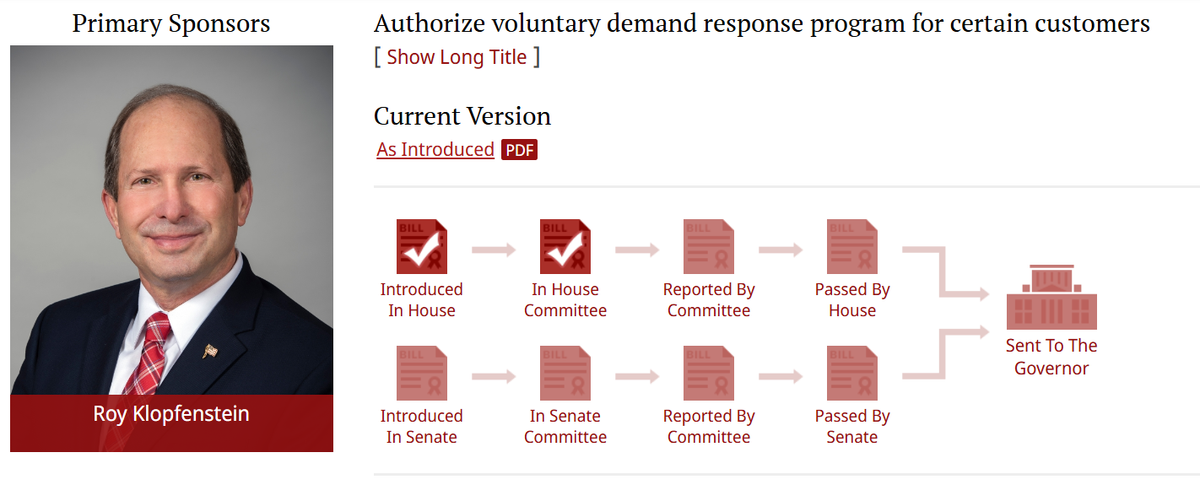
Ohio House Bill 427, introduced by State Representative Roy Klopfenstein, R-Haviland, aims to establish a formalized framework for demand-response programs across the state. Under the current text of the legislation, utility companies would be permitted to adjust participating residential and small commercial customers' high-energy appliances—such as smart thermostats and water heaters—during periods of peak electricity demand on the regional power grid.
While framed by proponents as a 'progressive, cost-saving tool' designed to modernize Ohio’s energy rules, optimize efficiency, and prevent catastrophic grid failures, critics argue the bill creates a troubling mechanism to buffer the massive power consumption of tech conglomerates. As Ohio's Wexner-style Public-Private partnetships move to position the state as the central hub for hyperscale data centers and corporate cloud processing, the regional electric grid has faced unprecedented strain. Because electricity must be consumed the moment it is generated, freeing up residential energy effectively creates a buffer that allows utility distributors to reroute power to high-demand industrial zones without triggering larger scale blackouts. In short, individual communities may pay the price so AI data centers can run uninterupted. While the bill in its current state offers the 'service' to throttle usage as a voluntary option for customers, critics argue the likelihood it remains as such under future grid strain is incredibly low.
This infrastructure bottleneck intersects directly with a burgeoning surveillance apparatus expanding across the state. According TOR's investigative report, the rapid expansion of artificial intelligence surveillance infrastructure in American communities and schools relies entirely on the high-density computational capacity provided by these water-cooled server farms multiplying across Ohio fields.
The physical data centers expanding in technology corridors near Columbus, New Albany, and Dublin host the massive processing grids required by commercial AI surveillance vendors. These platforms include campus safety software like Gaggle, which monitors the digital communications of approximately 5 million students nationwide, and biometric networks from vendors like CRB Cunninghams, which convert student facial anatomy into encrypted faceprint algorithms. Civil liberties advocates emphasize that the algorithmic power required to continuously store, sort, and map billions of daily keystrokes, biometric logs, and real-time behavioral data would be computationally impossible without Ohio’s expanding data center landscape.
Consequently, watchdogs argue that House Bill 427 functions as a backstop for tech corporations, leveraging residential conservation to keep the lights on for corporate data infrastructure. By allowing utilities to "throttle" a citizen's home energy usage during peak hours, the grid operator can maintain a seamless flow of continuous electricity to corporate repositories, effectively fueling the controversial AI dragnet under the guise of public safety and grid reliability.
This legislative maneuver comes as the Ohio Legislature swiftly moved to shield the tech industry from municipal accountability. Critics point out a coordinated push within the statehouse to organize the entire state apparatus to prevent citizens and local officials from taking legal action against developers. Parallel to HB 427, lawmakers are pushing forward House Bill 126, officially labeled the Prohibit Certain Public Nuisance Actions bill. HB 126 seeks to restrict local governments from bringing lawsuits against data center companies for community-wide, environmental impacts—such as draining regional aquifers, triggering localized droughts, or polluting groundwater supplies with contaminants.
By altering product liability codes to bar claims that commercial activities "unreasonably interfere with a right common to the general public," HB 126 effectively indemnifies data center developers against the cascading consequences of their rapid development. These unintended consequences are already surfacing across Central Ohio, where severe water usage has contributed to long-term groundwater subsidence and forced municipalities to implement strict water restrictions.
To reinforce this protective legal environment for big tech, the legislature is simultaneously advancing House Bill 646, which establishes a specialized data center committee. While major tech companies are slated to provide testimony to this commission to "explore and dispel rumors and myths," separate consumer advocacy bills—including House Bill 706 (the Ratepayer Protection Act) and House Bill 784 (requiring mandatory water consumption reporting)—continue to sit and languish without traction. Opponents argue the newly proposed commission is merely a corporate mouthpiece designed to validate a predetermined tech structure, utilizing HB 126 to preemptively strip communities of their democratic and legal recourse.
House Bill 427 was officially introduced during the 136th General Assembly and has been assigned to the House Energy Committee for initial review and testimony.
For Ohio citizens concerned about the intersection of grid management, corporate data expansion, and the erosion of local legal protections, several avenues for action remain available. Because the demand-response framework outlined in House Bill 427 is strictly voluntary, residents retain the ultimate authority to decline participation or opt out of automated utility adjustments entirely. Additionally, community members can track the official progress of these interlocking proposals through the Ohio Legislature website or contact their local representatives on the House Energy Committee to voice feedback before the bills face a committee vote.