State Finance Records Reveal Startling Revelation in Findlay; Who Is Really Running Findlay?

FINDLAY - Citizens in Findlay have been facing down many changes, with most occurring at near breakneck speed. Many have inquired on why the current push for zoning for data centers, which has gripped the city in equal parts frustration and anxiety, is occurring so quickly. Recently secured documents obtained by The Ohio Register show that Findlay Mayor Christina Muryn’s campaign committee and personal financial portfolios are directly tied to energy infrastructure firms and data center speculators at the heart of escalating local tensions over zoning, and potentially to a larger extent, the administrations general transparency.
The paper trail emerges amid escalating local tension over transparency and allegations that the administration allowed private development groups to vet city data center zoning laws ahead of the public. However, now, financial disclosures, filed with the Ohio Secretary of State’s office, show direct financial connections linking Muryn’s reelection committee to major industrial players positioned to benefit from regional data center expansion projects. The documents span over half a decade of Ohio Ethics Commission filings and may completely change a brewing local dispute over hidden zoning drafts into what could be a conflict of interest involving the Mayor's household and major industrial players positioned to benefit from regional data center expansions.
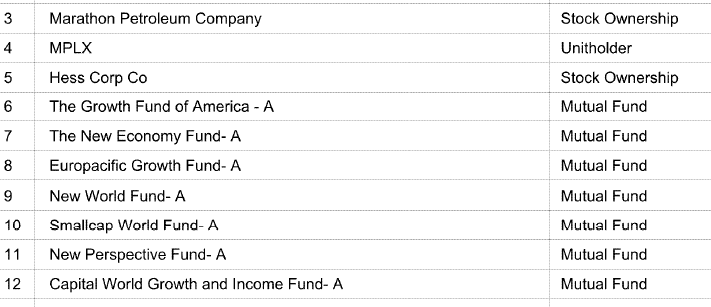
According to annual financial disclosure statements spanning 2020 through 2025, Muryn has maintained consistent personal equity in Marathon Petroleum Company and MPLX LP, listing herself as a stock owner and unitholder in the firms. MPLX and Marathon are both headquartered in Findlay.
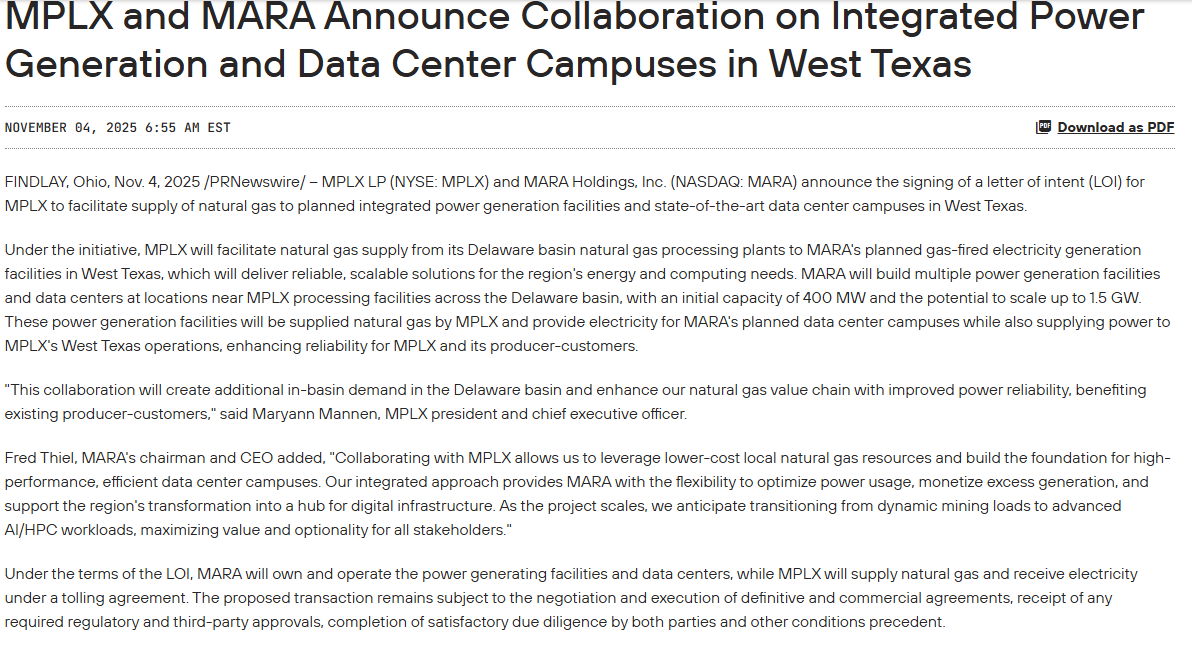
Those investments directly cross with massive regional data center projects. On November 4, 2025, MPLX LP and digital asset giant MARA Holdings, Inc. (NASDAQ: MARA) announced a formal collaboration via a letter of intent. Under the agreement, MPLX will supply natural gas from its processing plants to fuel MARA’s planned gas-fired electricity generation facilities and data center campuses.
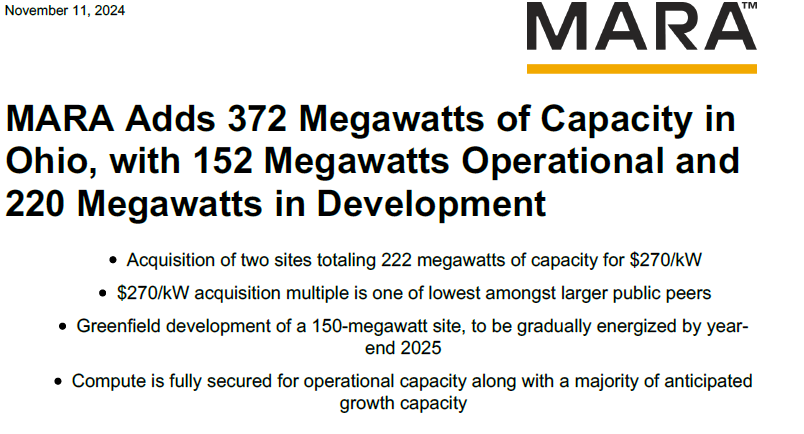
Simultaneously, MARA has targeted Findlay for development. Corporate records show MARA is building a 150-megawatt data center operation in Findlay, utilizing an existing 30-megawatt capacity baseline with plans to fully energize the greenfield site by the end of 2025.
The primary ethics filings show that Muryn’s ties to the executives steering these operations extend to personal disclosures. In her 2023 and 2024 filings, Muryn disclosed receiving food or beverages from Michael Hennigan, the Chief Executive Officer of Marathon Petroleum and Chairman of MPLX.
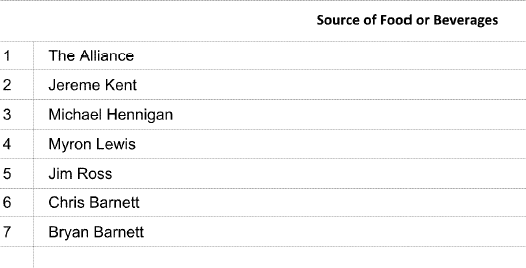
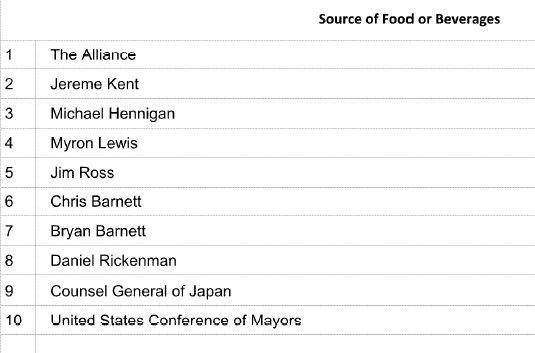
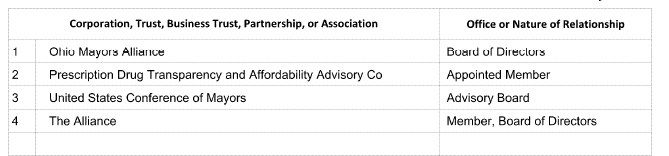
During the same period, she reported receiving food, beverages, or gifts from other regional economic stakeholders, including Jereme Kent, chief executive of One Power, the Findlay-Hancock County Economic Development office, and the Yale School of Management. It is also noted that she explicitly discloses her position as an active board member for "The Alliance". The Alliance is a private, investor-funded organization that embeds Findlay-Hancock County Economic Development directly into the city's executive planning. The Alliance acts as a localized node for Regional Growth Partnership, sharing data, site packages, and corporate alignment.
Campaign finance archives from the Ohio Secretary of State further document the political expenditures of Muryn's campaign committee. On October 9, 2025, the Committee to Elect Christina Muryn issued a $1,722.21 expenditure designated as a contribution to the One Power Company Ohio PAC.

Additionally, Muryn's personal disclosures regarding her other holdings include stock in most major players associated with data centers to date, NVIDIA, Microsoft, Apple, Amazon, and Meta Platforms, alongside specialized blockchain investments like the First Trust SkyBridge Crypto Industry & Digital Economy ETF.
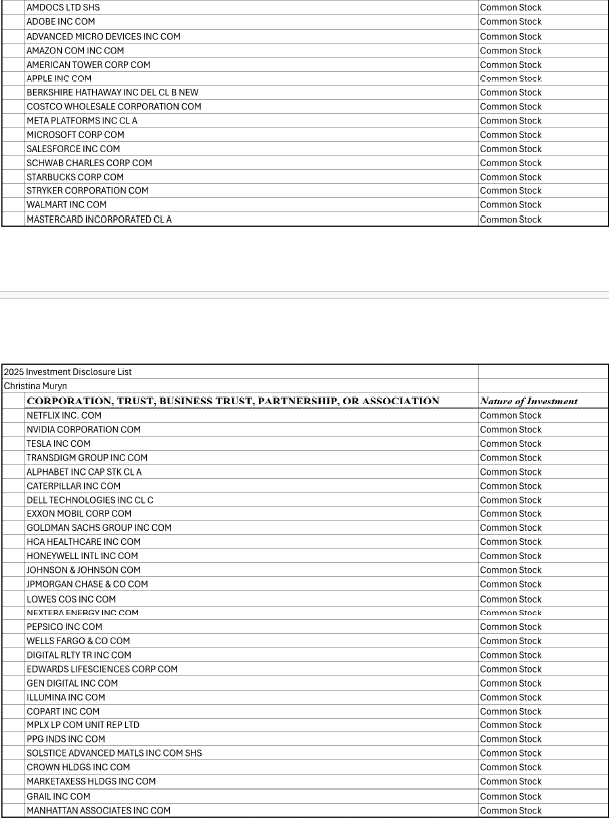
Unlike a 401(k) target-date fund, a personal Fidelity brokerage or self-directed Roth IRA typically require the account owner or spouse to actively log in and manually click "buy" on specific individual ticker symbols like NVIDIA, Microsoft, Apple, or Meta. By disclosing these line-by-line under her own name, it may confirm these are self-selected individual equities, rather than an automated aggregate package chosen by an employer's retirement program.
This overlapping web of corporate partnerships, personal equity, and political commerce exists against the backdrop of internal city communications from July 2026. Server logs surrendered by the city revealed that on July 22, 2026, the Findlay Planning and Zoning Committee advanced a draft data center ordinance after implementing sudden, strict revisions. These changes included expanding residential buffers to a uniform 1,000-foot setback and flattening groundwater extraction permissions for equipment cooling.
The sudden shift triggered an immediate internal administrative debate. At 5:44 a.m. on Thursday, July 23, Findlay official Daniel DeArment sent an urgent email to Mayor Muryn and planning director Matt Cordonnier lobbying against the 1,000-foot rule, stating that it "swung too far" and would consume "valuable farmland or prime industrial property".
Less than six hours later, at 11:15 a.m. on July 23, Muryn bypassed standard public tracks and emailed the confidential "Chapter 1144 Data Center Draft v7" document directly to Gary Thompson, Executive Vice President of the Regional Growth Partnership (RGP), writing, "Gary, Please see attached as discussed. Appreciate your feedback".
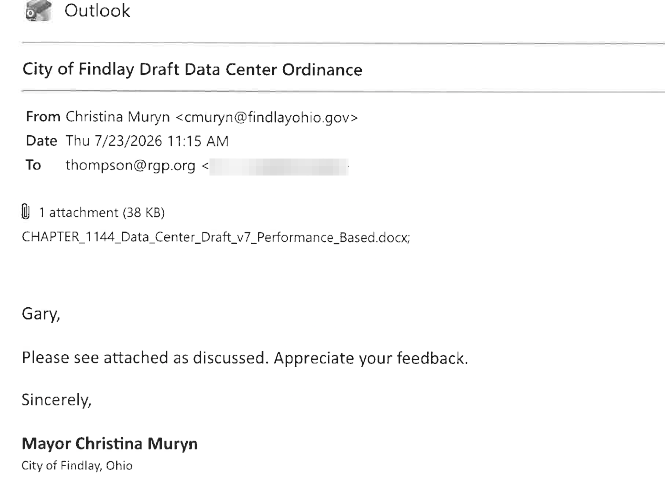
The private transmission gave RGP, a private non-profit serving as the regional network partner for JobsOhio, early access to vet the infrastructure legislation exactly one week before the text was formally rolled out to Findlay taxpayers via a public online information hub on July 30.
In some expert opinions, RGP acts as the private clearinghouse where developers map out multi-million dollar power upgrades and development deals. Mayor Muryn's submission of the draft zoning ordinance was sent to the executive leadership of the corporate economic network that heavily organizes Findlay’s corporate landscape and represents her largest individual and PAC financial supporters.
Traditional data centers buy power directly from the massive public utility grid (like AEP or FirstEnergy). However, the 'tech boom' has created a massive grid capacity crunch. Public utilities are taking years to approve the massive electric lines and substations needed to run AI and crypto facilities, creating an infrastructure bottleneck. This bottleneck is where One Power Company, Muryn's campaign contributor, makes its millions. They do not operate the data centers themselves; they act as the private "middlemen" of energy infrastructure.
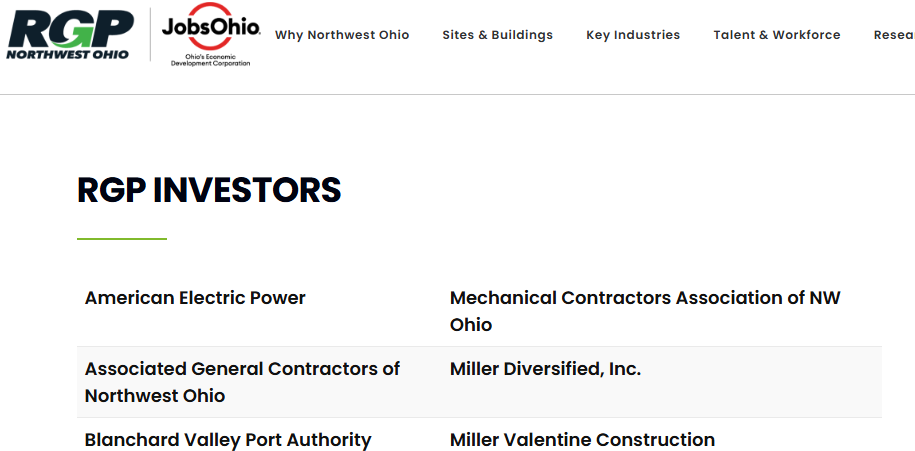
If the City of Findlay passed an emergency zoning law that was too strict, such as a mandatory 2,000-foot distance from industrial parks or a low cap on facility energy consumption, the millions of dollars One Power invested in that land would be wiped out. Some argue that giving the Regional Growth Partnership (RGP) early access to the zoning draft may have allowed the energy syndicate to ensure the final rules remained "flexible" enough to protect One Power's local pipeline, ensuring their heavy-load industrial footprints remained legally viable for incoming tech clients. AEP, the former parent umbrella of OnSite, which purchased One Power this year, is a major investor in RGP.
Many argue the ultimate goal for a regional utility speculator like One Power is to scale up local infrastructure projects to a point where they can be sold to massive global asset managers. Because One Power successfully pre-packaged these critical localized grids along Ohio's logistics corridors, the company became an incredibly lucrative acquisition target. This infrastructure strategy successfully paid off when Columbus-based OnSite Partners—a massive utility operator backed by the $7 billion global private equity powerhouse Basalt Infrastructure Partners, stepped in and swallowed up One Power's local footprint, the very entity tied into the Allen Township data center development.

As the 12-month data center moratorium ticks toward its expiration, the mounting friction in Hancock County highlights a wider national debate over who controls local municipal resources. For residents and city watchdogs, the paper trail connecting Mayor Muryn’s household portfolios to energy giants, her campaign war chest to localized utility speculators, and her administration’s back-channel communications with the Regional Growth Partnership may suggest that the rules governing the region's future were quietly vetted by corporate interests long before the public was ever invited to the table. While local government attorneys defend the practice as standard, pro-business administrative consulting, critics contend that the sophisticated legal loopholes, most notably exemplified by OnSite Partners’ multi-million dollar private equity pivot into neighboring Allen Township, have effectively reduced public town zoning into a private boardroom transaction. Ultimately, the battle over Findlay’s borders exposes a stark political paradox: as grassroots voters attempt to build decentralized political power a few dollars at a time, multi-billion-dollar utility networks continue to seamlessly leverage maximum-tier PAC capital to systematically shape the local laws, landscapes, and energy grids of Ohio.