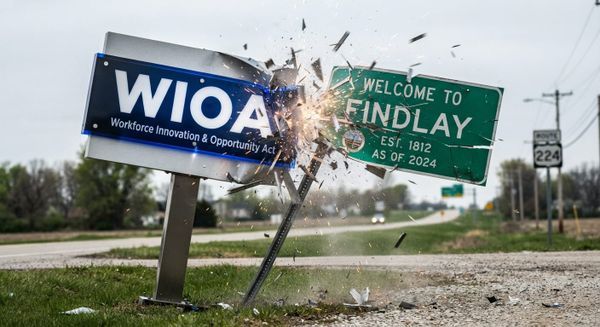
Who Killed Findlay's AI Transparency Ordinance?

BY CAREY MORGAN
FINDLAY — Behind-the-scenes emails obtained through an Ohio Public Records Act request show Findlay’s top legal and legislative leaders privately debated procedural hurdles to sideline a proposed artificial intelligence transparency ordinance last month — even as routine administration legislation submitted days later was drafted and passed without objection.
Records from the city’s October email archives detail how Law Director Robert Feighner and City Council President David Murphy weighed options on Oct. 20 to pull or reroute Ordinance No. 2026-119, an AI civic transparency measure submitted by City Auditor Jim Staschiak.
The communications stand in sharp contrast to internal emails from the same week showing city officials readily accepted, edited and passed other last-minute legislative requests from Mayor Christina Muryn’s administration without raising similar procedural questions.
Internal records confirm that Ordinance No. 2026-119 was formally assigned to the city auditor nearly a week before the Oct. 20 Regular Session City Council meeting.
At 10:03 a.m. on Wednesday, Oct. 14, Council Clerk Denise DeVore sent a draft legislative lineup to Deputy Auditor Ginger Sampson under the subject line "10/20/26 legislation."
"Attached is all the legislation that I have so far for the 10/20/26 Regular Session City Council meeting," DeVore wrote. "Ordinance No. 2026-119 is assigned to City Auditor Staschiak, but that he has not given me anything on it yet. Please review & let me know if you see anything that needs changed."
Staschiak subsequently delivered the ordinance text ahead of the meeting, and DeVore distributed the official Oct. 20 council agenda packet on Friday, Oct. 16.
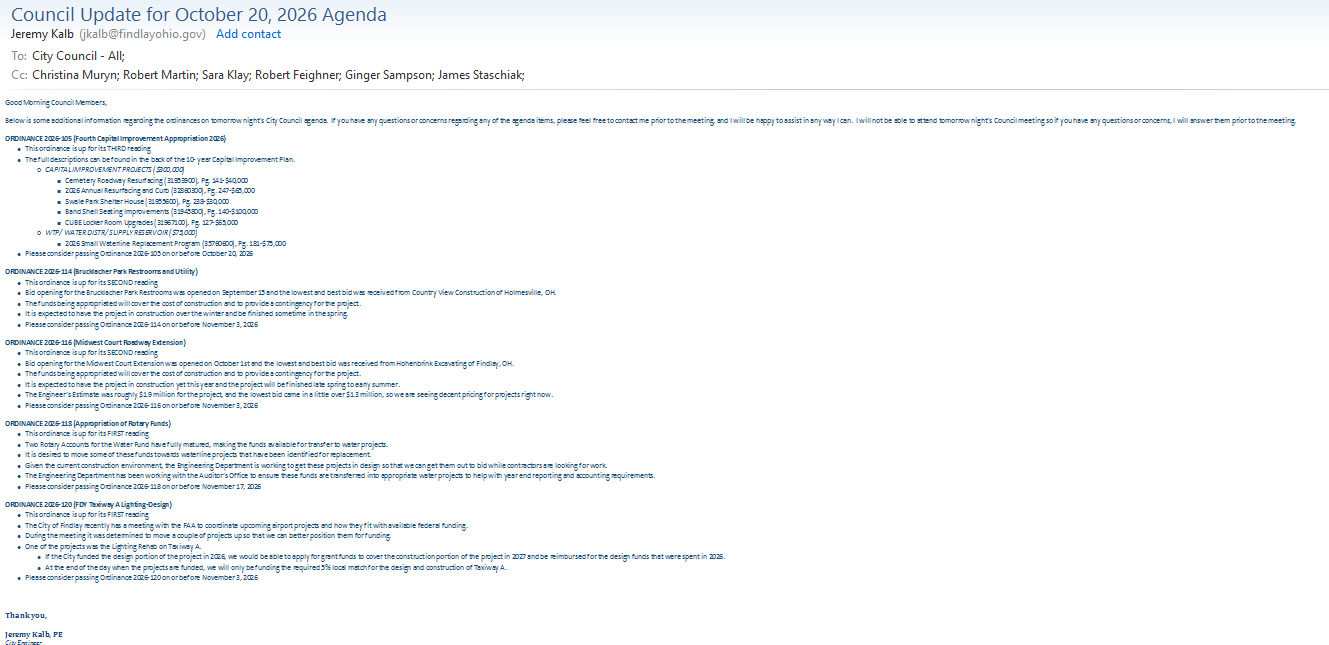
By Monday, Oct. 19, however, signs of the ordinance’s impending removal were already visible in administration briefings. At 8:53 a.m. that morning, City Engineer Jeremy Kalb sent a "Council Update" to all council members, Muryn and Feighner summarizing upcoming ordinances on the Oct. 20 agenda. Kalb’s summary listed Ordinances 2026-105, 2026-114, 2026-116, 2026-118 and 2026-120 — skipping directly over Ordinance 2026-119.
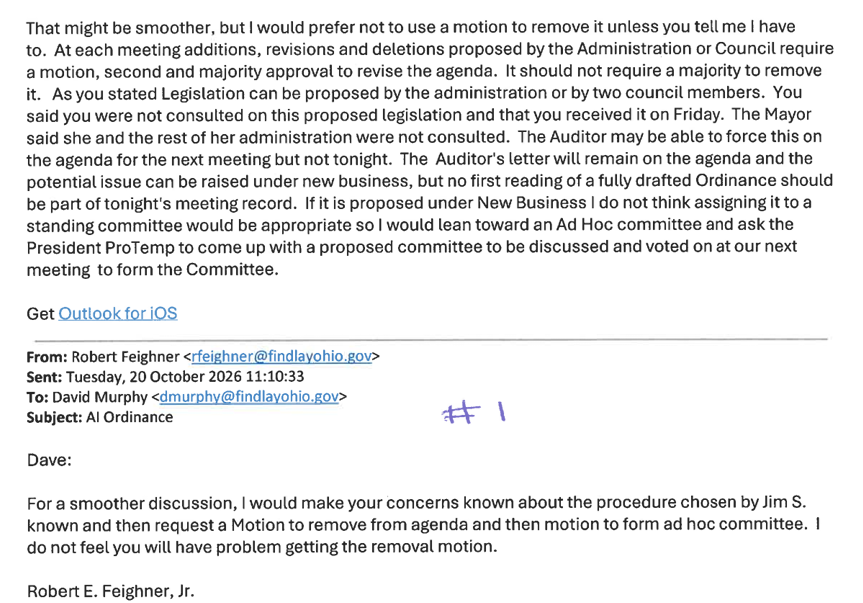
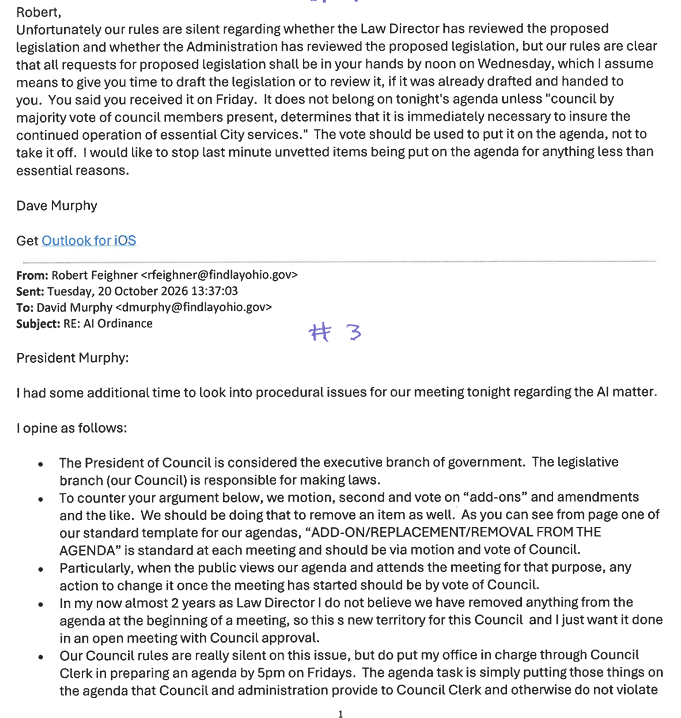
On Tuesday, Oct. 20 — the day of the City Council meeting — Murphy telephoned Feighner to raise concerns about how to handle Staschiak’s AI transparency ordinance, according to a four-email exchange between the two officials released by the city.
Following that phone call, Feighner emailed Murphy to outline their procedural options for keeping the measure off the floor or diverting it from a vote. In their exchange, the law director and council president debated whether the auditor’s submission of the legislation followed proper council procedure and discussed removing the item from the agenda or referring it to a committee rather than allowing it to proceed through standard council readings.
When council met that evening, Ordinance No. 2026-119 was sidelined. An official list of adopted legislation distributed by DeVore the following morning, Oct. 21, shows council passed five ordinances at the Oct. 20 session — skipping straight from earlier business to adopt Ordinances 2026-120 and 2026-121, with no adoption or recorded floor action on Ordinance 2026-119.
While Feighner and Murphy scrutinized the procedural validity of Staschiak’s pre-assigned ordinance, other emails from the same records production show that last-minute legislation and agenda modifications requested by the mayor’s administration were processed routinely and without pushback.
On Monday, Oct. 19 — three days after the official Oct. 20 council packet had already been distributed — DeVore emailed Sampson at 9:21 a.m. regarding a brand-new piece of legislation numbered immediately after Staschiak’s sidelined measure.
"Please review the attached add-on Ordinance No. 2026-121 for tomorrow’s (Tuesday 10/20/26) Regular Session City Council meeting & let me know if you see anything that needs changed," DeVore wrote. "The attached letter was on my desk when I came in this morning."

Sampson replied at 10:42 a.m., "This is ok." Ordinance No. 2026-121 was placed on the docket and adopted by council the next night.
Earlier in the month, emails show city officials exercised similar flexibility for administration requests. At 2:13 p.m. on Oct. 5 — the afternoon before the Oct. 6 council meeting — Kalb emailed DeVore and Sampson a Word document with the subject "Add On Letter for Council," noting simply, "Attached is an add on letter for tomorrow night’s Council." Sampson confirmed the cover letter was in order, and the item moved forward.
Two hours later that same afternoon, at 4:24 p.m., DeVore sent a "High Importance" email to Finance Committee Chair BJ Preston relaying a last-minute request from Muryn to alter the next day’s Finance Committee agenda. DeVore noted that Muryn wanted budget items added but "did not want to list whose salaries (elected officials & administrative staff) & only wanted 'salaries' listed."
Administration staff also routinely swapped revised legislative drafts via email without formal committee gatekeeping. On Oct. 13 and Oct. 15, officials substituted updated versions of a Rotary Fund appropriation letter and Ordinance No. 2026-120 directly with clerk and auditor staff ahead of scheduled readings.
Despite the paper trail surrounding routine ordinances, the city’s public records production contains a five-day gap regarding Ordinance No. 2026-119 between DeVore’s Oct. 14 email confirming the ordinance number was assigned to Staschiak and Murphy’s Oct. 20 phone call to Feighner.
In his cover letter releasing the records, Feighner stated that city IT searches for "Staschiak" and "City Auditor" returned numerous hits. While the city’s export included dozens of automated accounting receipts and external newsletters — including two Oct. 21 policy newsletters sent to Muryn’s inbox that matched a keyword search for "AI" — no internal emails between Oct. 15 and Oct. 20 discussing the text of Ordinance No. 2026-119, the decision to omit it from Kalb’s agenda briefing, or consultations between the mayor, law director and council president were produced.